
Citizen’s Charter in India: Strengthening Citizen-Centric Governance
GS-2, Unit-2, Sub Unit-1, HPAS Mains
In a democracy like India, where governance involves direct interaction between citizens and the state, the delivery of efficient, transparent, and accountable services is of utmost importance. One of the instruments created to achieve this is the Citizen’s Charter, which seeks to bridge the gap between service providers and service seekers by clearly defining rights, responsibilities, and standards of public service.
Origin and Concept
The idea of a Citizen’s Charter was first introduced in the United Kingdom in 1991 under Prime Minister John Major, aiming to make public services more responsive and accountable. Inspired by this model, India adopted the concept in 1997, when the Department of Administrative Reforms and Public Grievances (DARPG) launched an “Action Plan for Effective and Responsive Government.” Since then, various ministries, departments, and public sector units have been formulating their own Citizen’s Charters.
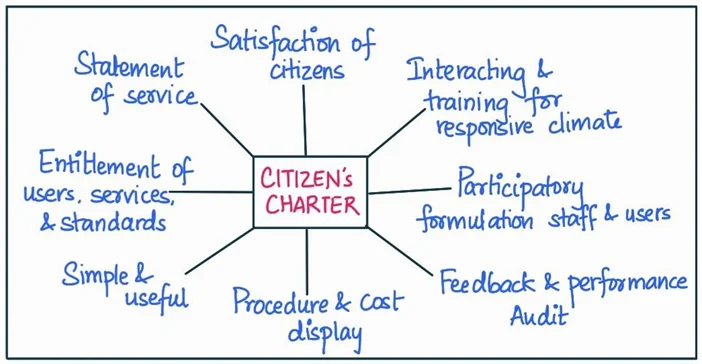
A Citizen’s Charter is essentially a written declaration by a public authority that informs citizens about the services it offers, the standards of those services, time frames for delivery, and the remedies available if services are not provided as promised.
Objectives of Citizen’s Charters in India
The charters are designed to bring governance closer to people. Their key objectives include:
- Enhancing accountability of public officials and institutions.
- Defining service standards in a clear and time-bound manner.
- Promoting transparency in government functioning.
- Ensuring grievance redressal mechanisms for dissatisfied citizens.
- Encouraging citizen participation by highlighting their roles and responsibilities.
Key Principles of Citizen’s Charter
To ensure effectiveness, Citizen’s Charters are based on six guiding principles:
- Quality – Improving the quality of services delivered to citizens.
- Choice – Providing options wherever possible, so citizens are not dependent on a single service provider.
- Standards – Setting clear benchmarks for service delivery, including time frames.
- Value for Money – Ensuring efficient use of public resources to benefit citizens.
- Accountability – Making officials answerable for delays, inefficiency, or poor service.
- Transparency – Sharing information openly about services, procedures, and grievance mechanisms.
These principles collectively aim to make governance citizen-centric and responsive.
Key Features
An effective Citizen’s Charter in India usually contains the following elements:
- Vision and Mission Statement – The overall goals and commitments of the department.
- Details of Services Provided – Clear information on services and procedures.
- Service Standards – Time limits and quality benchmarks for delivery.
- Grievance Redressal Mechanism – Contact details of officers responsible for addressing complaints.
- Expectations from Citizens – The responsibilities of citizens, such as providing accurate information and timely cooperation.
Examples in India
Over the years, many organizations have adopted Citizen’s Charters. For example:
- The Indian Railways outlines service timelines for ticket bookings, refunds, and complaint handling.
- The Passport Seva Project specifies time frames for passport issuance and grievance resolution.
- State governments, such as Madhya Pradesh and Bihar, have enacted Right to Public Services Acts, giving legal backing to some of the provisions of Citizen’s Charters.
Challenges in Implementation
Despite its potential, the Citizen’s Charter initiative in India has faced multiple hurdles:
- Lack of awareness among citizens regarding the existence of charters.
- Non-binding nature of commitments, as most charters do not have legal enforceability.
- Poor drafting, with technical language and vague promises that are hard to measure.
- Weak grievance redressal, where citizens often face delays in getting complaints addressed.
- Resistance from bureaucracy, as some officials perceive it as an additional workload.
Recommendations for Improvement
To make Citizen’s Charters more impactful in India, certain steps are necessary:
- Legal Backing – Giving statutory status to service standards, as seen in state-level Right to Public Services legislations.
- Stakeholder Consultation – Involving citizens, civil society, and service users in drafting charters to ensure relevance.
- Capacity Building – Training officials to adopt a more citizen-centric approach.
- Use of Technology – Introducing online platforms for grievance redressal and real-time tracking of services.
- Regular Monitoring – Conducting periodic reviews and independent audits to ensure compliance.
Conclusion
The Citizen’s Charter in India represents a significant step toward making governance transparent, accountable, and citizen-friendly. While the initiative has laid down the foundation for improved service delivery, its impact has been limited due to weak implementation and lack of enforcement. Strengthening the charters with legal backing, digital integration, and citizen participation can transform them into a powerful tool of participatory democracy.
Ultimately, Citizen’s Charters are not just policy documents—they are social contracts that can rebuild trust between the government and its people, ensuring that governance works in the best interests of citizens.
For UPSC Coaching in Chandigarh Join Today Nimbus Academy for IAS.