
Indian Constitution: Historical Underpinnings, Evolutionary Phases & Salient Features
GS-2, Unit-1, Sub Unit-1, HPAS Mains
The Constitution of India is not merely a legal document — it is the foundational framework that defines the political, social, and economic structure of the world’s largest democracy. It reflects the historical experiences of colonial rule, the aspirations of the freedom struggle, and the vision of nation-builders who sought to create a just and inclusive society. Understanding the Constitution requires examining its historical roots, the stages through which it evolved, and the distinctive features that make it unique among modern constitutions.
Historical Underpinnings of the Indian Constitution
The roots of the Indian Constitution lie deep in the colonial administrative and legal developments introduced by the British. Over nearly two centuries, British rule gradually introduced institutions, laws, and governance practices that shaped constitutional thinking in India.
The early regulatory measures such as the Regulating Act of 1773 and Pitt’s India Act of 1784 established parliamentary control over the East India Company and created centralized governance. Later, the Charter Acts (1813, 1833, 1853) introduced legislative reforms and opened civil services gradually.
A major turning point came after the Revolt of 1857. The Government of India Act, 1858 transferred power from the East India Company to the British Crown, beginning direct imperial rule. Subsequent acts — particularly the Indian Councils Acts of 1861 and 1892 — introduced limited legislative participation by Indians.
The early 20th century saw constitutional reforms driven by rising nationalism:
- Morley–Minto Reforms (1909) introduced separate electorates.
- Montagu–Chelmsford Reforms (1919) introduced dyarchy in provinces.
- Government of India Act, 1935 — the most important colonial constitutional document — provided provincial autonomy, a federal scheme, and administrative structures that later influenced the Indian Constitution heavily.
Parallel to British reforms, Indian political leaders developed their own constitutional visions through documents like:
- Nehru Report (1928)
- Karachi Resolution (1931)
- Various proposals of the Indian National Congress
These developments created both institutional experience and ideological direction for constitution-making.
Evolutionary Phases of the Indian Constitution
The making of the Indian Constitution was not sudden — it evolved through clear political and institutional stages.
- Demand for a Constituent Assembly
The idea that Indians should frame their own Constitution gained momentum in the 1930s. The demand was strongly supported by the Indian National Congress and other national leaders. In 1940, the British government accepted the principle indirectly through the August Offer.
- Cabinet Mission Plan (1946)
The Cabinet Mission proposed the formation of a Constituent Assembly elected indirectly by provincial legislatures. This became the foundation of constitution-making in India.
- Formation of Constituent Assembly
The Constituent Assembly first met on 9 December 1946. Dr. Rajendra Prasad became its President. Though the Muslim League initially boycotted it, the Assembly continued its work. After Partition, membership was reduced.
- Drafting Process
A Drafting Committee chaired by Dr. B.R. Ambedkar was appointed in August 1947. The committee examined constitutional models worldwide and incorporated suitable features. The draft Constitution was published in 1948 and debated clause by clause.
The Assembly took:
- 2 years, 11 months, and 18 days
- 11 sessions
- Extensive debates and amendments
- Adoption and Enforcement
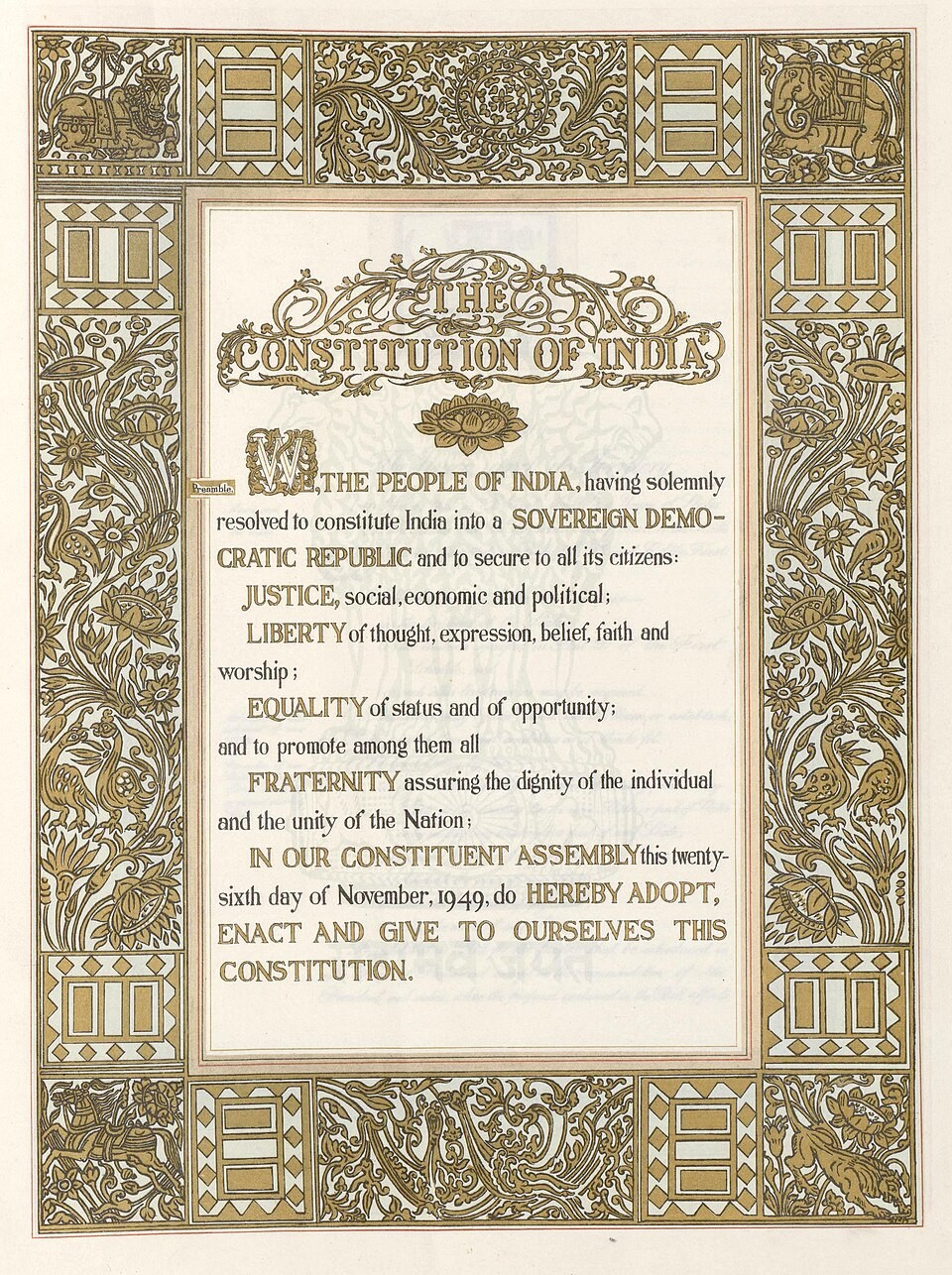
The Constitution was adopted on 26 November 1949 and came into force on 26 January 1950, chosen to honour the Purna Swaraj Declaration of 1930. India became a sovereign democratic republic on that day.
Sources and Influences
The Indian Constitution is often described as a “bag of borrowings,” but these borrowings were carefully adapted to Indian conditions.
Major influences include:
- British Constitution — parliamentary system, rule of law, cabinet government
- US Constitution — fundamental rights, judicial review
- Irish Constitution — Directive Principles of State Policy
- Canadian Constitution — federal structure with strong centre
- Australian Constitution — concurrent list, trade provisions
- Government of India Act 1935 — administrative framework
Salient Features of the Indian Constitution
The Indian Constitution stands out due to its depth, detail, and inclusive vision. Its key features include:
- Lengthiest Written Constitution
It is one of the longest written constitutions in the world. It contains detailed provisions covering governance, rights, administration, and emergency powers.
- Sovereign, Socialist, Secular, Democratic, Republic
These ideals — stated in the Preamble — express the philosophical foundation of the Constitution:
- Sovereign — independent authority
- Socialist — social and economic justice
- Secular — equal respect for all religions
- Democratic — government by the people
- Republic — elected head of state
- Parliamentary System
India follows the parliamentary model where the executive is responsible to the legislature. The Prime Minister and Council of Ministers hold real executive power.
- Federal System with Unitary Bias
Though federal in structure with division of powers between Centre and States, the Constitution gives stronger powers to the Centre, especially during emergencies.
- Fundamental Rights
Part III guarantees Fundamental Rights such as equality, freedom, and protection against exploitation. These are enforceable by courts and form the backbone of civil liberty.
- Directive Principles of State Policy
These are non-justiciable guidelines directing the state to promote welfare, social justice, and economic democracy. They shape governance goals.
- Fundamental Duties
Added by the 42nd Amendment, these outline moral obligations of citizens toward the nation.
- Independent Judiciary
An autonomous judiciary with the Supreme Court at the apex ensures constitutional supremacy and protects rights through judicial review.
- Universal Adult Franchise
Every adult citizen has the right to vote regardless of caste, gender, religion, or wealth — a bold democratic step from the beginning.
- Single Citizenship
Unlike some federations, India provides single citizenship for national unity.
- Emergency Provisions
The Constitution provides for National, State, and Financial Emergencies, allowing temporary centralization of power when required.
- Amendment Procedure
The Constitution is neither too rigid nor too flexible. Amendments can be made through different procedures depending on the subject.
Conclusion
The Indian Constitution is a product of historical experience, nationalist vision, and careful institutional design. It evolved from colonial administrative frameworks but transformed them into democratic instruments serving a sovereign people. Its framers balanced liberty with order, diversity with unity, and rights with responsibilities.
More than seven decades later, it continues to guide India’s democratic journey, adapt through amendments, and serve as a living document. Understanding its historical underpinnings, evolutionary process, and salient features reveals why it remains one of the most remarkable constitutional achievements in modern history.
Note: Topic important for UPSC IAS Preparation, HPAS, State PCS