
Published by Nimbus Academy
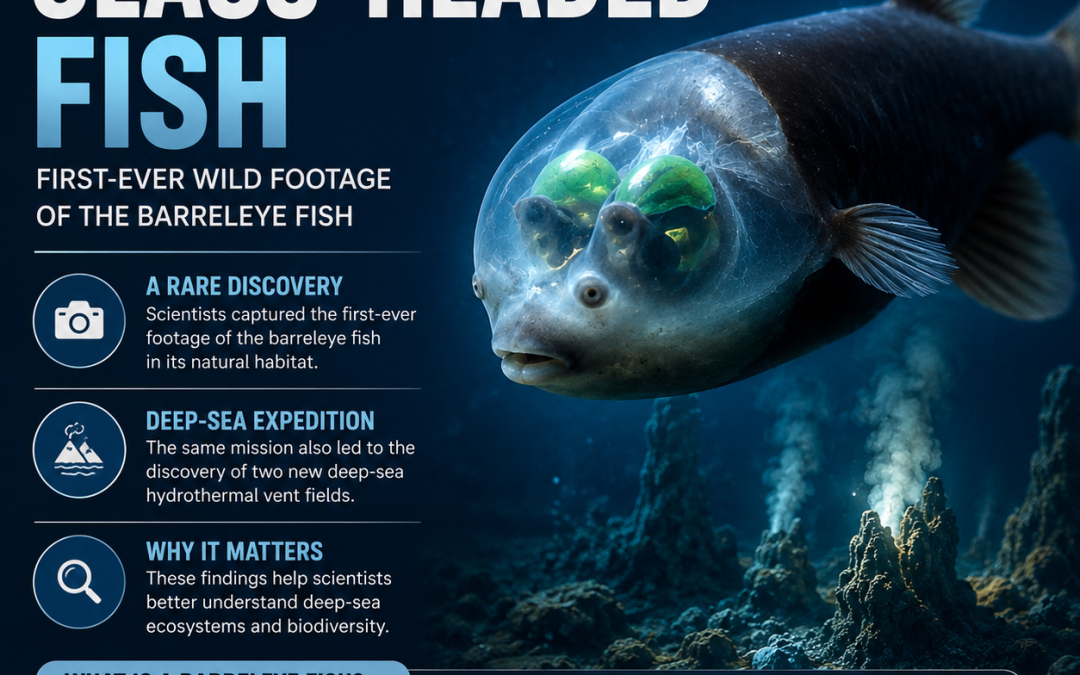
The deep ocean remains one of the least explored regions on Earth, with scientists estimating that a significant portion of it is still unmapped. In a remarkable scientific breakthrough, researchers have successfully recorded the first-ever footage of the elusive Barreleye Fish (Macropinna microstoma) in its natural habitat. The discovery has generated global interest among marine biologists and highlights how modern technology continues to transform our understanding of deep-sea ecosystems.
The Discovery
The historic sighting took place during a 35-day deep-sea expedition in the Doldrums Fracture Zone of the Atlantic Ocean near Brazil. Scientists deployed the remotely operated vehicle (ROV) SuBastian, equipped with advanced 4K imaging systems, to explore depths of nearly 710 metres (2,329 feet).
During the expedition, researchers encountered a live Barreleye Fish swimming naturally in the deep ocean. Unlike earlier observations based on damaged specimens collected in fishing nets, this footage captured the fish exhibiting its natural behaviour in its undisturbed environment.
Why Is the Barreleye Fish So Unique?
The Barreleye Fish is regarded as one of the most unusual vertebrates found in the ocean due to its remarkable anatomical adaptations.
Key Features
- Transparent Head: The fish possesses a transparent, fluid-filled dome that protects its sensitive eyes.
- Rotating Tubular Eyes: Its bright green eyes can rotate from an upward position to a forward-facing position, allowing it to detect prey with exceptional accuracy.
- Deep-Sea Habitat: It inhabits depths of approximately 600–800 metres, where sunlight is almost completely absent.
- Exceptional Low-Light Vision: Its visual system is specially adapted to survive in one of Earth’s darkest environments.
These adaptations enable the Barreleye Fish to locate food efficiently while conserving energy in the nutrient-poor deep sea.
Why Is This Discovery Significant?
Although the Barreleye Fish was first described scientifically in 1939, nearly all previous knowledge came from preserved or damaged specimens. Its delicate transparent head often collapsed after being brought to the surface, making it difficult for researchers to study its true appearance.
The latest expedition provides scientists with valuable information about:
- Natural swimming behaviour
- Eye movement and hunting techniques
- Adaptations for deep-sea survival
- Ecological role within deep-ocean food chains
Such observations help improve scientific understanding of biodiversity in extreme marine environments.
Additional Scientific Discoveries
The expedition yielded more than just the sighting of the Barreleye Fish. Researchers also identified two previously unknown hydrothermal vent fields on the ocean floor.
Hydrothermal vents release mineral-rich, superheated water and support unique ecosystems that thrive without sunlight through chemosynthesis. These ecosystems are among the most biologically significant environments in the deep ocean and remain a major focus of marine research.
Relevance for UPSC, HPAS & Other Competitive Examinations
This development is important from the perspective of competitive examinations because it relates to several syllabus areas.
Static Topics
- Marine Biodiversity
- Adaptation and Evolution
- Oceanography
- Deep-Sea Ecosystems
- Hydrothermal Vents
Current Affairs Linkage
- Scientific Discoveries
- Marine Research
- Biodiversity Conservation
- Deep-Sea Exploration
- Environmental Science & Technology
Questions based on recent scientific discoveries are frequently asked in UPSC, HPAS, PCS, and other state civil service examinations.
Exam-Oriented Facts
| Topic | Details |
| Scientific Name | Macropinna microstoma |
| Common Name | Barreleye Fish |
| Habitat | Deep Atlantic and Pacific Oceans |
| Depth | Approximately 600–800 metres |
| Special Feature | Transparent head with rotating tubular eyes |
| Latest News | First-ever wild footage captured during a 35-day deep-sea expedition |
| Other Discovery | Two new hydrothermal vent fields identified |
Conclusion
The successful recording of the Barreleye Fish in its natural habitat marks a significant milestone in marine science. It demonstrates how advances in underwater exploration are helping scientists uncover the mysteries of the deep ocean while expanding our understanding of biodiversity and evolution.
For civil services aspirants, this discovery is an excellent example of how current affairs connect with subjects such as Environment, Ecology, Geography, and Science & Technology. Staying updated with such developments not only enhances general awareness but also strengthens preparation for competitive examinations.
Stay connected with Nimbus Academy for reliable, exam-oriented coverage of important national and international current affairs, scientific discoveries, and environmental developments relevant to UPSC, HPAS, HAS, PCS, and other competitive examinations.