
From UN to WTO: Structure and Mandates of Key Global Bodies
In today’s interconnected world, international institutions, agencies, and fora play a central role in shaping global governance. They facilitate cooperation among nations, manage conflicts, regulate economic relations, and address global challenges such as poverty, health crises, and climate change. Among these, the United Nations, World Trade Organization, International Monetary Fund, and World Bank stand out as key pillars. Understanding their structure and mandates helps in analyzing how the global system operates.
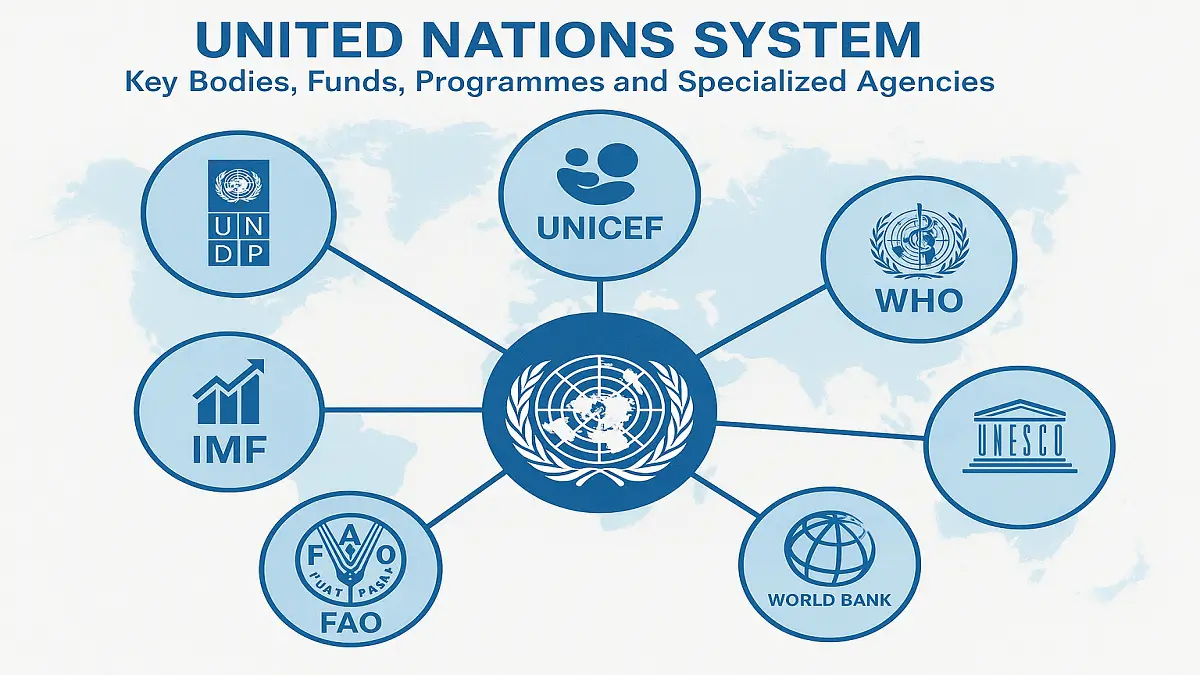
- United Nations (UN): Structure and Mandate
The United Nations, established in 1945, is the most comprehensive global organization with the primary aim of maintaining international peace and security.
Structure:
The UN has six principal organs:
- General Assembly – deliberative body with equal representation of all member states
- Security Council – responsible for peace and security (5 permanent members with veto power)
- Economic and Social Council (ECOSOC) – coordinates economic and social issues
- International Court of Justice (ICJ) – judicial organ
- Secretariat – administrative body
- Trusteeship Council – now inactive
It also functions through specialized agencies like the World Health Organization and UNESCO.
Mandate:
- Maintain global peace and security
- Promote human rights
- Foster international cooperation
- Support sustainable development
- World Trade Organization (WTO): Structure and Mandate
The World Trade Organization, established in 1995, regulates global trade.
Structure:
- Ministerial Conference – highest decision-making body
- General Council – oversees daily operations
- Dispute Settlement Body – resolves trade disputes
- Trade Policy Review Body – reviews trade policies
- Various councils for goods, services, and intellectual property
Mandate:
- Promote free and fair trade
- Ensure predictability in trade rules
- Resolve disputes among member countries
- Monitor national trade policies
- International Monetary Fund (IMF): Structure and Mandate
The International Monetary Fund was created in 1944 to ensure global financial stability.
Structure:
- Board of Governors – highest authority
- Executive Board – handles day-to-day operations
- Managing Director – head of the IMF
Voting power is based on financial contributions, giving more influence to developed countries.
Mandate:
- Ensure monetary stability
- Provide financial assistance during crises
- Offer policy advice
- Promote international monetary cooperation
- World Bank: Structure and Mandate
The World Bank focuses on development and poverty reduction.
Structure:
- Board of Governors
- Executive Directors
- President of the World Bank
It consists of institutions like IBRD and IDA.
Mandate:
- Reduce poverty
- Provide development loans and grants
- Support infrastructure and human development
- Promote sustainable economic growth
- G20: An Informal Global Forum
The G20 represents a different model of global governance.
Structure:
- No permanent secretariat
- Annual summits of leaders
- Rotating presidency
Mandate:
- Promote global economic stability
- Coordinate responses to financial crises
- Encourage policy dialogue among major economies
- Role of Regional Organizations
Regional bodies like the European Union complement global institutions.
Structure:
- European Parliament
- European Commission
- European Council
Mandate:
- Regional integration
- Economic cooperation
- Political coordination
Such organizations strengthen global governance by addressing region-specific issues.
- Challenges and Need for Reform
Despite their importance, these institutions face several issues:
- Power imbalance (e.g., veto power in UN Security Council)
- Lack of representation of developing countries
- Institutional inefficiency and slow decision-making
- Difficulty in addressing modern challenges like climate change and pandemics
Reforms are needed to make them more inclusive, transparent, and effective.
Conclusion
From the United Nations to the World Trade Organization, global institutions form the backbone of international cooperation. Each organization has a distinct structure and mandate, yet they are interconnected in maintaining global stability and development. As the world faces new and complex challenges, strengthening and reforming these institutions becomes essential to ensure a more balanced, equitable, and effective global order.
Note: Topic important for UPSC, HPAS, State PCS