
Indian Polity Basics: Parliament, Executive and Judiciary Explained
GS-2, Unit-1, Sub Unit-2, HPAS Mains
India’s democratic system rests on a carefully designed institutional framework that distributes power among three key organs — the Legislature, Executive, and Judiciary. This structure is rooted in the Constitution and guided by the principle of checks and balances, ensuring that no single authority becomes too powerful. These institutions together shape how laws are made, implemented, and interpreted across the country.
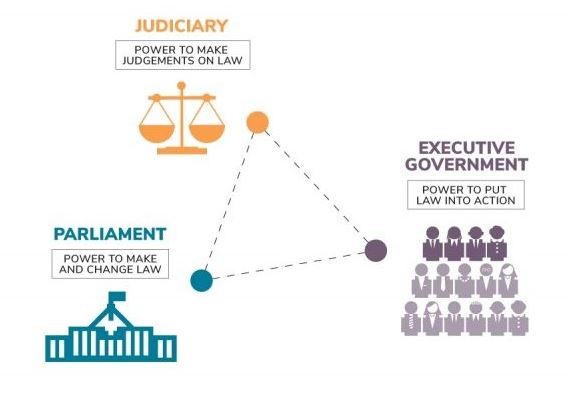
To understand how India’s governance works in practice, it is important to look at these three pillars closely. Here’s a simple breakdown of each.
- The Legislature: The Law-Making Body
The Legislature is responsible for making laws and representing the will of the people. In India, the legislative structure exists at both the Union (central) and State levels.
Parliament at the Union Level
India has a bicameral Parliament, meaning it has two Houses:
- Lok Sabha (House of the People)
Members are directly elected by citizens. It is the more powerful House in financial matters and government formation. The majority party or coalition here forms the government. - Rajya Sabha (Council of States)
Members are elected indirectly by State legislatures. It represents the states of India and acts as a revising chamber. - President of India
The President is also a formal part of Parliament. A bill becomes law only after receiving Presidential assent.
Key Functions of Parliament
- Making laws
- Passing the budget and financial bills
- Holding the Executive accountable through questions and debates
- Approving constitutional amendments
- Discussing national policies and issues
State Legislatures
At the state level, legislatures can be:
- Unicameral — Only Legislative Assembly (Vidhan Sabha)
- Bicameral — Legislative Assembly + Legislative Council (Vidhan Parishad) in some states
The State Legislature makes laws on subjects listed in the State List and Concurrent List of the Constitution.
- The Executive: The Law-Implementing Authority
The Executive is responsible for implementing laws and running the day-to-day administration. It also exists at both Union and State levels.
Union Executive
The Union Executive includes:
President of India
- Constitutional head of the country
- Acts on the advice of the Council of Ministers
- Appoints Prime Minister, judges, governors, and other officials
- Supreme Commander of Armed Forces (ceremonial role in practice)
Prime Minister
- Real executive authority
- Leader of the majority in Lok Sabha
- Heads the government
- Coordinates ministries and policy decisions
Council of Ministers
- Includes Cabinet Ministers, Ministers of State, and Deputy Ministers
- Responsible collectively to the Lok Sabha
- Runs different government departments
Bureaucracy (Civil Services)
- Permanent executive
- Includes IAS, IPS, and other services
- Implements government policies and programs
State Executive
At the state level, the structure is similar:
- Governor — Constitutional head of the state (appointed by President)
- Chief Minister — Real executive head
- Council of Ministers — Assists the Chief Minister
- State Civil Services — Administrative machinery
- The Judiciary: The Law-Interpreting Body
The Judiciary interprets laws, settles disputes, and protects the Constitution. It acts as a guardian of rights and ensures that laws and executive actions remain within constitutional limits.
India follows a single integrated judicial system — unlike some federal countries where state and federal courts are separate.
Structure of the Indian Judiciary
Supreme Court of India
- Highest court in the country
- Final court of appeal
- Guardian of the Constitution
- Can strike down unconstitutional laws (Judicial Review)
- Handles Centre–State disputes
High Courts
- Highest court at the state or group-of-states level
- Supervises lower courts
- Hears appeals and constitutional matters
Subordinate Courts
- District and Sessions Courts
- Civil and Criminal Courts
- Handle most day-to-day cases
Key Powers of the Judiciary
- Judicial Review — Can invalidate unconstitutional laws
- Protection of Fundamental Rights
- Interpretation of the Constitution
- Writ jurisdiction under Articles 32 and 226
- Public Interest Litigation (PIL)
Judicial independence is protected through security of tenure, fixed service conditions, and a separate appointment and removal process.
- Separation of Powers — But Not Absolute
India follows the principle of separation of powers, but not in a strict sense. Instead, it adopts a functional separation with checks and balances.
Examples:
- Executive is drawn from Legislature (PM and Ministers are MPs/MLAs)
- Legislature checks Executive through questions, motions, and committees
- Judiciary reviews laws made by Legislature
- Executive appoints judges (with judicial participation through collegium system)
- President can return bills for reconsideration
This interdependence ensures cooperation along with accountability.
- How the Three Organs Work Together
Governance is not about isolated functioning — it is about coordination.
Example flow:
- Legislature passes a law
- Executive implements the law
- Judiciary interprets disputes arising from the law
If the Executive misuses power, Legislature questions it. If Legislature passes an unconstitutional law, Judiciary can strike it down. If Judiciary overreaches, constitutional amendments may redefine limits.
This dynamic balance keeps democracy functional.
- Why This Structure Matters
This three-pillar model protects democracy by:
- Preventing concentration of power
- Ensuring accountability
- Protecting citizen rights
- Maintaining rule of law
- Promoting stable governance
For exam aspirants, understanding these basics helps in polity, governance, and constitutional topics. For citizens, it builds awareness about how authority and responsibility are distributed.
Conclusion
India’s governance system is built on a strong constitutional foundation dividing authority among the Legislature (law-making), Executive (law-implementing), and Judiciary (law-interpreting). While each has distinct roles, their coordinated functioning and mutual checks ensure democratic stability. Knowing how these institutions operate is key to understanding how the Indian state functions in practice — not just in theory.
Note: Topic important for UPSC, HPAS, State PCS