
Institutional framework, Policies and Interventions for development in various sectors in India
Citizen Charter: A Tool for Good Governance and Accountability
In a democratic polity like India, governance is not merely about exercising authority — it is about serving citizens efficiently, transparently, and responsibly. Over time, the demand for better public service delivery, transparency, and accountability led to the introduction of an important administrative reform known as the Citizen Charter. Conceived as a tool to make public institutions more citizen-centric, the Citizen Charter represents a commitment by government departments and agencies to uphold defined standards of service.
But how far has it succeeded in strengthening good governance? Let us examine its concept, objectives, significance, challenges, and the way forward.
What is a Citizen Charter?
A Citizen Charter is a formal document issued by a public organization that outlines:
- The services it provides
- The standards of service delivery
- The time frame within which services will be delivered
- The grievance redressal mechanism available to citizens
The idea of the Citizen Charter first emerged in the United Kingdom in 1991 under Prime Minister John Major as part of the “Citizen’s Charter Initiative.” Inspired by this model, India adopted the concept in 1997 during the Chief Ministers’ Conference on Effective and Responsive Administration. Since then, several central and state government departments have adopted Citizen Charters to enhance transparency and accountability.
Citizen Charter and Good Governance
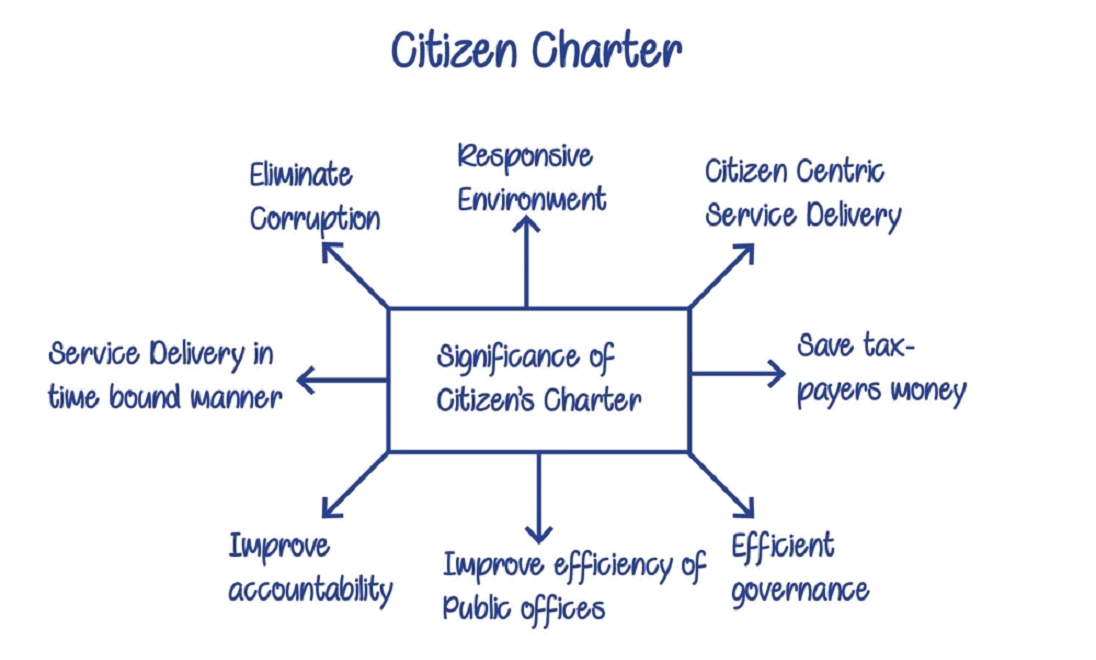
Good governance rests on principles such as transparency, accountability, responsiveness, efficiency, equity, and rule of law. The Citizen Charter directly contributes to many of these principles.
- Transparency
By clearly listing services, procedures, and timelines, Citizen Charters reduce ambiguity. Citizens know what to expect from government offices, which minimizes arbitrary decisions and corruption.
- Accountability
When service standards and timelines are clearly stated, government officials can be held accountable for delays or deficiencies. The Charter acts as a public commitment, creating moral and administrative responsibility.
- Responsiveness
Citizen Charters make governance more citizen-centric. Instead of citizens adjusting to bureaucratic convenience, the administration commits itself to serving people efficiently.
- Improved Service Delivery
Defined time limits and service benchmarks push departments to streamline processes. This reduces red tape and enhances administrative efficiency.
- Grievance Redressal
Most Citizen Charters include a grievance redressal mechanism. This empowers citizens to raise complaints when services are not delivered as promised.
Core Components of an Effective Citizen Charter
For a Citizen Charter to truly function as a tool of accountability, it must include certain essential elements:
- Clear service standards (time-bound delivery)
- Simple language easily understandable by citizens
- Contact details of responsible officers
- Grievance redressal procedures with timelines
- Periodic review and revision
Without these elements, a Citizen Charter risks becoming a mere formality rather than a transformative instrument.
Achievements in India
In India, many departments such as Passport Seva, Railways, Municipal Corporations, and Income Tax have adopted Citizen Charters. Some sectors have shown tangible improvement:
- Passport services now follow defined timelines under the Passport Seva initiative.
- Income tax refunds are processed within stipulated time limits.
- Online portals have increased transparency and tracking of applications.
Digital governance initiatives like e-governance platforms have strengthened the effectiveness of Citizen Charters by allowing citizens to monitor service delivery in real time.
Challenges in Implementation
Despite its potential, the Citizen Charter mechanism in India faces several limitations:
- Lack of Legal Backing
Most Citizen Charters are not legally enforceable. They are statements of intent rather than binding obligations. Hence, failure to meet standards often goes unpunished.
- Poor Awareness
Many citizens are unaware of the existence of Citizen Charters. Without awareness, the Charter cannot serve as a tool of empowerment.
- Unrealistic Standards
Some departments set vague or impractical service benchmarks, which defeats the purpose of accountability.
- Weak Grievance Redressal
In many cases, grievance mechanisms lack independence and effectiveness, leading to citizen frustration.
- Absence of Periodic Review
Citizen Charters are sometimes drafted once and not updated, making them outdated and irrelevant.
Recognizing these issues, the Second Administrative Reforms Commission recommended that Citizen Charters should be realistic, measurable, and periodically reviewed. It also emphasized the need for citizens’ participation in drafting them.
Citizen Charter and Ethical Governance
From an ethical perspective, Citizen Charters promote values such as integrity, responsibility, empathy, and commitment to public welfare. They align with the broader goals of administrative ethics by ensuring that public servants remain answerable to the people.
In fact, Citizen Charters complement other transparency measures such as the Right to Information Act, 2005, which empowers citizens to demand information from public authorities. Together, these instruments strengthen democratic accountability.
The Way Forward
To make Citizen Charters truly effective, several reforms are necessary:
- Legal enforceability through service guarantee laws.
- Integration with digital platforms for tracking and transparency.
- Citizen participation in drafting and evaluation.
- Independent grievance redressal authorities.
- Regular audits and performance evaluation.
Some Indian states have enacted Public Service Guarantee Acts, which provide statutory backing to time-bound service delivery. Expanding such legal frameworks nationwide would significantly enhance accountability.
Conclusion
The Citizen Charter is a significant step toward transforming traditional bureaucratic governance into citizen-centric administration. It bridges the gap between government and people by setting clear expectations and standards. While challenges persist in implementation, awareness, and enforceability, the concept remains a powerful instrument for promoting transparency and accountability.
In essence, a well-designed and effectively implemented Citizen Charter strengthens the democratic promise that government exists to serve its citizens — not the other way around. When backed by legal force, technological support, and genuine administrative will, it can become a cornerstone of good governance in India.
Note: Topic important for UPSC IAS, HPAS, State PCS