
Introduction
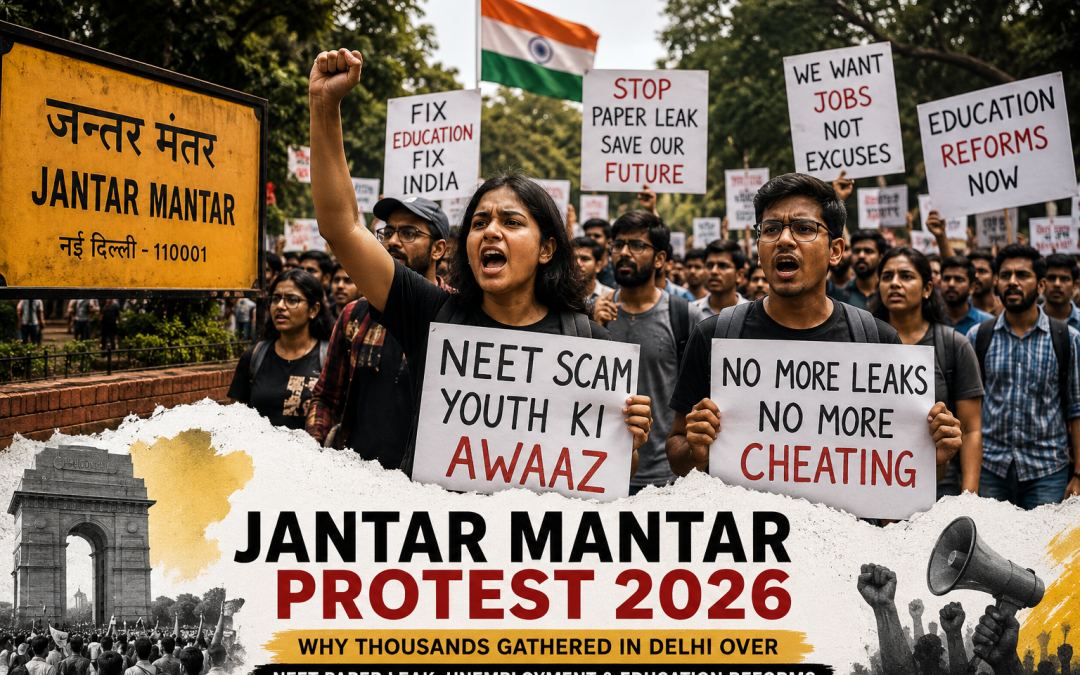
New Delhi’s Jantar Mantar has once again become the center of a major national movement. Thousands of students, teachers, parents, and civil society members have assembled to demand accountability over the alleged NEET examination paper leaks, rising youth unemployment, and broader reforms in India’s education system.
The protest has gained nationwide attention due to the involvement of education reformer Sonam Wangchuk, who has been on a prolonged hunger strike and described the campaign as India’s “Second Freedom Movement.” As Parliament’s Monsoon Session begins, authorities have significantly tightened security around central Delhi, making this one of the most closely watched protests of 2026.
What is Happening at Jantar Mantar?
The demonstration began as a student-led campaign demanding justice for candidates affected by repeated examination controversies, particularly allegations surrounding the NEET examination paper leak.
Over the past few weeks, the protest has expanded into a broader youth movement focusing on:
- Examination transparency
- Accountability in recruitment exams
- Youth unemployment
- Education reforms
- Protection of students’ rights
- Government accountability
The organizers planned a “Sansad Chalo” (March to Parliament) on 20 July 2026, intending to take these demands directly to lawmakers.
Why Are Students Protesting?
The movement is driven by growing frustration over repeated examination irregularities and employment concerns.
The key demands include:
- Investigation into NEET Paper Leak
Students are demanding an independent investigation into the alleged paper leak and strict punishment for those responsible.
- Fair Recruitment Process
Protesters argue that repeated examination leaks destroy the future of honest students and undermine trust in public examinations.
- Education Reforms
The movement seeks structural reforms to make entrance examinations more transparent, secure, and accountable.
- Employment Opportunities
Youth groups have linked examination issues with rising unemployment, arguing that delays and irregularities in recruitment worsen career uncertainty.
Sonam Wangchuk’s Role
Education reformer and environmental activist Sonam Wangchuk has emerged as one of the movement’s most recognizable faces.
He has been observing a hunger strike while urging citizens to participate peacefully. Wangchuk described the campaign as a fight for justice, transparency, and democratic accountability, referring to it as India’s “Second Freedom Movement.”
According to reports, Wangchuk was taken to a hospital after his health deteriorated due to dehydration, a move that his supporters criticized as an unnecessary detention rather than purely medical intervention.
Heavy Security Across Delhi
With Parliament’s Monsoon Session beginning, Delhi Police imposed extensive security arrangements around central Delhi.
Authorities:
- Increased police deployment
- Installed barricades around sensitive areas
- Enhanced surveillance
- Restricted public gatherings in parts of New Delhi
- Warned that unauthorized marches toward Parliament could invite legal action
Officials stated that permission had not been granted for the proposed Parliament march and cited public order concerns.
The Planned Parliament March
Thousands of protesters assembled at Jantar Mantar with plans to march toward Parliament on 20 July.
Participants included:
- Students
- Teachers
- Professionals
- Parents
- Social activists
- Civil society organizations
The organizers emphasized peaceful demonstration while demanding that Parliament address examination reforms and youth issues.
Political Reactions
The issue has entered the political arena, with opposition parties calling for discussions during Parliament’s Monsoon Session on:
- NEET paper leak allegations
- Education governance
- Youth unemployment
- Recruitment transparency
Government representatives, meanwhile, have defended administrative actions taken to maintain law and order around Parliament and have emphasized security considerations.
Why This Protest Matters
The Jantar Mantar protest is no longer limited to one examination.
For many participants, it symbolizes broader concerns about:
- Credibility of competitive examinations
- Equal opportunity for students
- Public trust in recruitment systems
- Employment prospects for young people
- Institutional accountability
The scale of participation has made it one of the most prominent youth-led movements in recent years.
Timeline of Events
| Date | Event |
| Late June 2026 | Hunger strike begins at Jantar Mantar |
| Early July 2026 | Student participation increases nationwide |
| Mid July 2026 | Protest expands to include education reforms and unemployment |
| 18–19 July 2026 | Sonam Wangchuk hospitalized after health concerns |
| 19 July 2026 | Delhi Police announces restrictions and heightened security |
| 20 July 2026 | Planned “Sansad Chalo” march coincides with the start of Parliament’s Monsoon Session |
What Happens Next?
The coming days are expected to determine whether:
- The protesters’ demands receive parliamentary attention.
- The government announces additional measures related to examination security or education reform.
- The demonstrations continue beyond the opening of the Monsoon Session.
With large crowds, heightened security, and sustained public attention, developments at Jantar Mantar are likely to remain a significant national story.
Conclusion
The 2026 Jantar Mantar protest has evolved into a broader movement centered on educational integrity, employment opportunities, and public accountability. While authorities have prioritized security around Parliament, protesters argue that repeated examination controversies and concerns about youth employment require systemic reforms. The response from Parliament and the government during the Monsoon Session will shape the next phase of this movement.