
The Making of Modern India: Battles, Reforms & Transformations (1757–1980)
GS-1, Unit-1, Sub Unit-1, HPAS Mains
India’s transformation from a cluster of regional kingdoms to a modern democratic republic is a story filled with wars, reforms, revolutions, and visionary leadership. Between 1757 and 1980, the subcontinent underwent its most dramatic changes — from colonial conquest to independence, from economic exploitation to planned development, and from traditional structures to modern institutions.
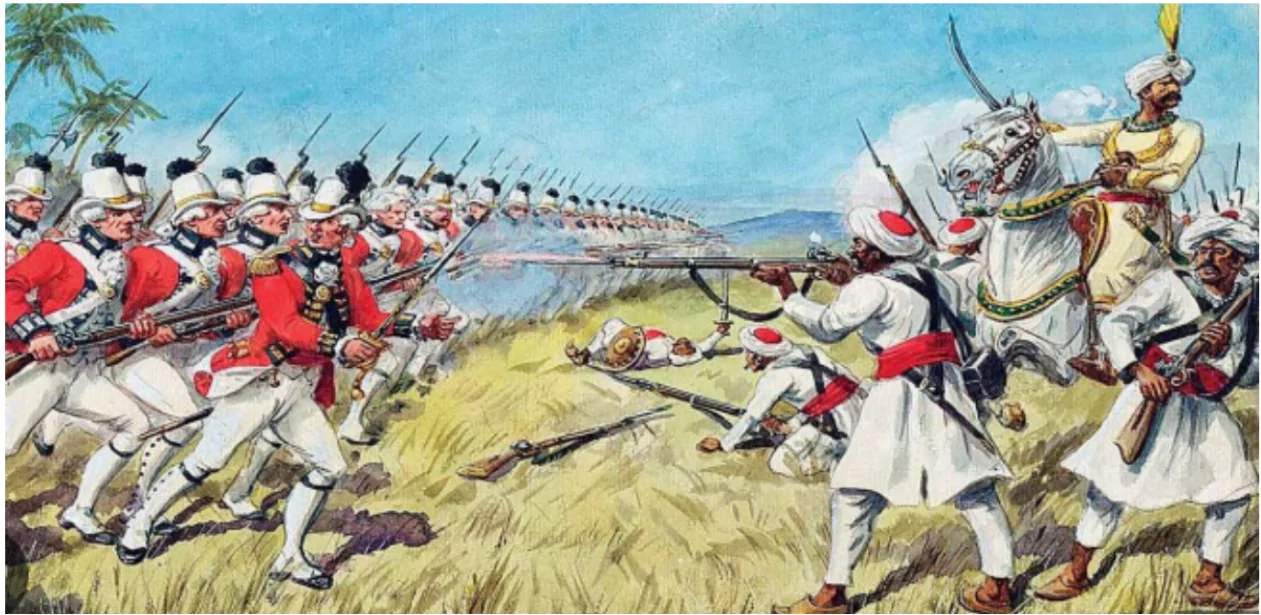
The Beginning of Colonial Dominance (1757–1857)
The Battle of Plassey (1757) marked the rise of the British East India Company as a political force. What began as a trading corporation gradually evolved into a ruling power that transformed the subcontinent.
Major Battles & Expansions
- Battle of Plassey (1757) – Victory over Siraj-ud-Daulah established Company control in Bengal.
- Battle of Buxar (1764) – Secured authority over Bengal, Bihar, and Orissa.
- Anglo-Mysore Wars (1767–1799) – Defeat of Tipu Sultan ended Mysore’s resistance.
- Anglo-Maratha Wars (1775–1818) – Collapse of the Maratha Confederacy.
- Anglo-Sikh Wars (1845–1849) – Annexation of Punjab, the last major independent kingdom.
Administrative & Economic Changes
- Introduction of Diwani rights and revenue systems like Permanent Settlement and Ryotwari.
- Expansion of plantation economy and decline of traditional crafts.
- Start of modern education with Macaulay’s Minute (1835).
- Social reforms led by Raja Ram Mohan Roy, Ishwar Chandra Vidyasagar, and others.
This period cemented British rule but also ignited early resistance.
- The First War of Independence & Rise of Nationalism (1857–1905)
The Revolt of 1857 was a major watershed. Though unsuccessful, it revealed deep resentment and altered British administration.
Aftermath of 1857
- End of Company Rule; India came under the British Crown.
- Policies of divide-and-rule, loyalty, and tighter administration.
- Expansion of railways, telegraphs, and bureaucracy.
Rise of Early Nationalism
- Establishment of the Indian National Congress (1885).
- Moderates demanded representation, civil rights, and Indianisation of services.
- Growth of socio-religious reforms: Brahmo Samaj, Arya Samaj, Aligarh Movement.
Swadeshi Movement (1905)
- Triggered by the Partition of Bengal.
- Boycott of foreign goods and promotion of Swadeshi industries.
- Rise of the Lal-Bal-Pal triumvirate.
This era laid the ideological and organisational foundation for the freedom struggle.
- Gandhian Era & the Freedom Struggle (1915–1947)
The arrival of Mahatma Gandhi transformed nationalism into a mass movement rooted in non-violence and Satyagraha.
Key Movements
- Champaran & Kheda Satyagraha – Early experiments in mobilisation.
- Non-Cooperation Movement (1920–22) – Boycott of schools, courts, titles.
- Civil Disobedience Movement (1930–34) – Salt March, defiance of colonial laws.
- Quit India Movement (1942) – A nationwide call for British withdrawal.
Revolutionary Movements
- Actions of Bhagat Singh, Chandrashekhar Azad, and Surya Sen.
- Formation of the Indian National Army (INA) led by Subhas Chandra Bose.
Path to Independence
- Government of India Acts (1919, 1935) introduced limited reforms.
- Post–World War II pressures pushed Britain to leave.
- Independence & Partition (1947) created India and Pakistan, along with widespread violence.
This phase defined India’s political consciousness and national identity.
- Rebuilding a Nation: 1947–1964 (Nehru Era)
Independence came with major challenges: refugee resettlement, economic revival, and political integration.
Political Integration
- Sardar Vallabhbhai Patel merged over 560 princely states.
- Adoption of the Constitution (1950) under Dr. B. R. Ambedkar.
- Establishment of a parliamentary democracy.
Economic & Social Policies
- Launch of Five-Year Plans and emphasis on public sector industries.
- Creation of institutions like IITs, AIIMS, and INCOSPAR (precursor to ISRO).
- Land reforms and rural development programmes.
- Reinforcement of secularism and non-alignment.
This era laid India’s institutional, industrial, and democratic foundations.
- Political Shifts & Social Transformations (1964–1980)
After Nehru, Indian politics experienced leadership changes, wars, and new social currents.
Key Developments
- Indo-China War (1962) and Indo-Pak Wars (1965, 1971) influenced defence priorities.
- The Green Revolution made India agriculturally self-sufficient.
- Rise of Indira Gandhi and consolidation of Prime Ministerial power.
- Bangladesh Liberation War (1971) enhanced India’s global influence.
The Emergency (1975–77)
- Declared due to political unrest and economic crisis.
- Suspension of civil liberties, press censorship, and mass detentions.
- Ended with elections restoring democracy.
Post-Emergency Period
- Weak Janata Party coalition fell apart.
- Indira Gandhi returned to power (1980).
- Rise of regional movements and economic difficulties marked this phase.
Conclusion
The making of modern India from 1757 to 1980 is a story of struggle, resilience, reform, and nation-building. From colonial domination to the formation of a sovereign republic, and from exploitation to development planning, India’s journey reflects the combined effort of leaders, reformers, freedom fighters, and millions of citizens. The foundations laid during this period continue to shape the nation’s political, economic, and social trajectory.
Note: Topic important for UPSC, HPAS, State PCS