
New Space India Limited (NSIL): Driving India’s Space Economy
GS-3, Unit-2, Sub Unit-1, HPAS Mains
India’s space journey, spearheaded by the Indian Space Research Organisation (ISRO), has inspired global admiration for its cost-effective and innovative missions. From the Chandrayaan and Mangalyaan programs to the recent Aditya-L1 solar mission, India has consistently demonstrated space capability at par with global leaders. To further harness this potential and unlock the commercial dimension of space, New Space India Limited (NSIL) was established as the commercial arm of ISRO.
Background and Establishment
NSIL was incorporated in March 2019 under the Department of Space, Government of India, as a Central Public Sector Enterprise (CPSE). Headquartered in Bengaluru, it was created to meet the growing demand for space-based services and to actively engage with India’s expanding private sector in the space ecosystem.
Unlike its predecessor, Antrix Corporation Limited (formed in 1992), which primarily handled exports and marketing of ISRO products, NSIL was envisioned with a broader mandate: to transfer ISRO’s technologies to industries, commercialize space products, and lead end-to-end space missions for customers.
Objectives and Mandate
The primary goals of NSIL are:
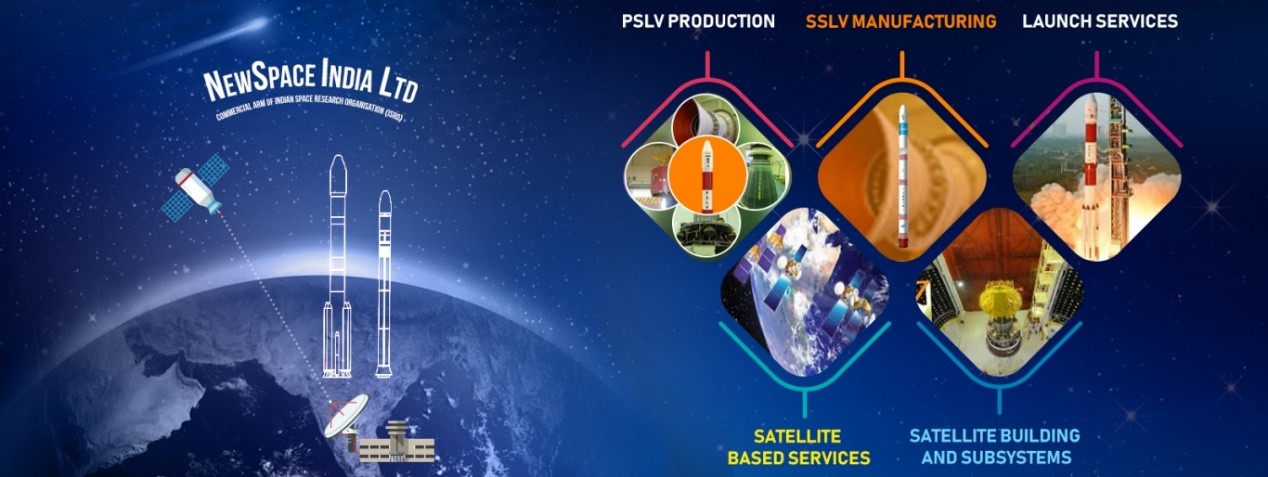
- Commercial Launch Services: Facilitate the use of ISRO’s launch vehicles, including PSLV and GSLV, for global clients.
- Satellite Building and Leasing: Build and lease satellites to domestic and international customers.
- Technology Transfer: Transfer ISRO’s technologies to Indian industries to strengthen the private space ecosystem.
- End-to-End Solutions: Offer turnkey solutions ranging from satellite launch to operationalization of space-based services like communication, earth observation, and navigation.
- Boosting Private Sector Participation: Serve as a link between ISRO and emerging private players in India’s space sector, ensuring India remains competitive in the global market.
Key Achievements So Far
Since its inception, NSIL has made remarkable progress in positioning itself as India’s commercial space hub:
- Satellite Launch Services: NSIL has coordinated launch contracts for global clients using ISRO’s reliable PSLV and GSLV rockets. For example, in June 2022, NSIL successfully launched GSAT-24, a communication satellite built by ISRO for Tata Play, entirely on a commercial basis.
- Technology Transfer: The company has been instrumental in transferring over 30 ISRO-developed technologies to industries, including satellite-based services, materials, and propulsion systems.
- First Demand-Driven Satellite: The GSAT-24 mission marked NSIL’s first demand-driven model, where the satellite was built, launched, owned, and operated by NSIL, and its capacity leased to customers.
- Global Collaborations: NSIL has signed agreements with international satellite operators, highlighting India’s growing role in the global space market.
- Promoting Small Satellite Launches: With the growing trend of small satellites for communication and earth observation, NSIL is actively marketing ISRO’s Small Satellite Launch Vehicle (SSLV) to global clients.
Significance for India’s Space Economy
India’s space sector is estimated to reach $13 billion by 2025 (EY-ISpA report), with growing demand for satellites, launch services, and data-driven applications. NSIL is central to this vision for several reasons:
- Revenue Generation: By commercializing ISRO’s products and services, NSIL ensures revenue streams for reinvestment into research and innovation.
- Global Competitiveness: With cost-effective launch vehicles like PSLV and SSLV, NSIL helps India compete with giants like SpaceX and Arianespace in the global launch market.
- Empowering Private Industry: NSIL acts as a catalyst for Indian private companies, fostering a space start-up culture and enabling collaboration with ISRO.
- Strategic Autonomy: By providing end-to-end satellite solutions, India reduces dependence on foreign players for space-based services.
Strategic Significance
NSIL is central to India’s ambition to scale up its commercial space economy—expected to surge from ~$13 billion today to potentially $77 billion by 2030
- Industry-led scaling: Partnerships with HAL, private satellite firms, and ground infrastructure developers are activating the industrial ecosystem.
- Global competitiveness: Cost-efficient launches like SSLV offer competitive edge in worldwide small-satellite markets.
- Revenue generation & Reinvestment: Commercial satellite services and launch contracts create steady income for R&D reinvestment.
- Geopolitical outreach: Cross-border launches (e.g., Nepal) position India as a regional space enabler.
- Technological democratization: From LVM3 to ground station networks, NSIL is catalyzing space technology accessibility across private players.
Challenges Ahead
While NSIL has made a promising start, challenges remain:
- Global Competition: Competing with heavily funded global players like SpaceX, Blue Origin, and OneWeb requires rapid scaling.
- Technology Upgradation: To meet diverse client demands, NSIL must continuously integrate cutting-edge technology and innovation.
- Private Sector Integration: India’s private space industry is still in its early stages; NSIL must balance between commercialization and enabling private enterprises.
- Policy Ecosystem: The success of NSIL depends on clear and supportive regulatory frameworks under India’s space policy.
Future Outlook
The trajectory ahead is promising:
- SSLV commercial operations starting late 2025 opens up high-frequency small-launch capabilities.
- LVM3 manufactured by private industry will expand payload reach.
- Ground station network will strengthen satellite operations and data accessibility.
- Tech transfers and PPPs—especially in earth observation satellite constellations—will empower private players further
Conclusion
New Space India Limited represents a new chapter in India’s space story—one that blends scientific excellence with economic opportunity. By serving as a bridge between ISRO and the commercial world, NSIL is not only creating a thriving space economy but also reinforcing India’s position as a reliable and innovative space power. As the space industry shifts from government-driven exploration to commercial exploitation, NSIL stands at the forefront of making India’s space dreams globally impactful.
If you are thinking to get preparation for UPSC IAS, Join Nimbus Academy for IAS Coaching in Chandigarh.