
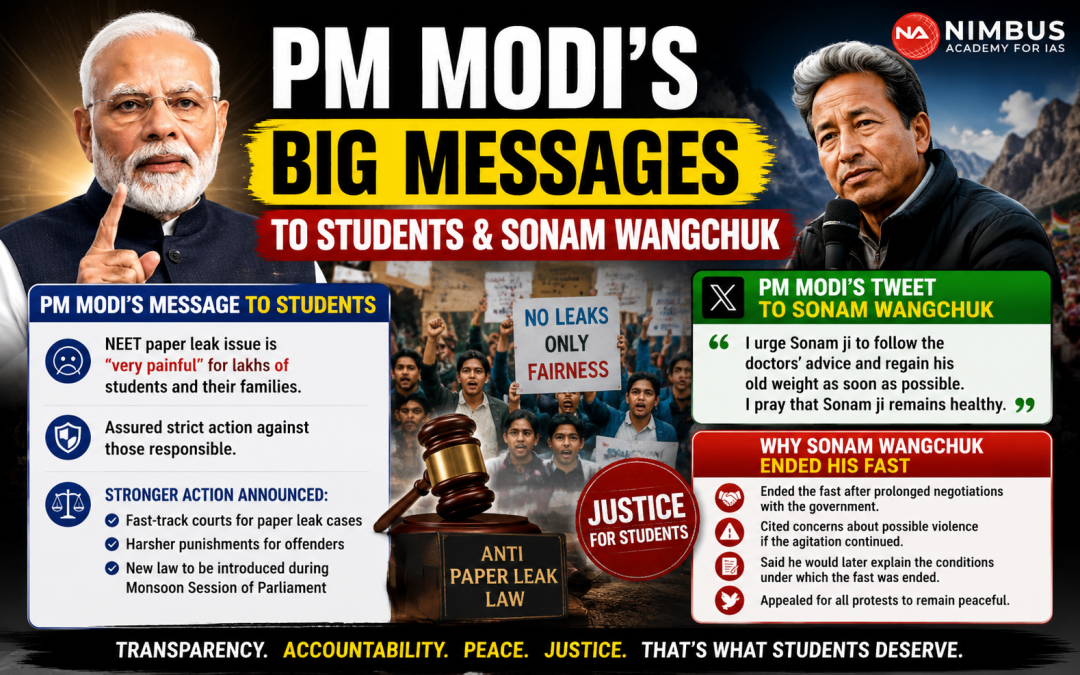
The past few weeks have been marked by two major developments that captured national attention. On one hand, lakhs of students across India have been demanding accountability over the NEET paper leak controversy. On the other, environmentalist and education reformer Sonam Wangchuk concluded his 26-day hunger strike after prolonged negotiations with the government.
Amid these developments, Prime Minister Narendra Modi addressed both issues through a public video message for students and a separate message on X (formerly Twitter) for Sonam Wangchuk. His statements have become a major talking point in the country’s political and educational discourse.
PM Modi’s Message to Students
Addressing the nation, Prime Minister Modi acknowledged the anxiety and frustration faced by students affected by the NEET paper leak.
He described the incident as “very painful” for lakhs of students and their families, emphasizing that honest students should never suffer because of corruption or malpractice in examinations.
The Prime Minister assured students that the government would act firmly against those responsible for the paper leak.
Stronger Measures Against Paper Leaks
To restore confidence in India’s examination system, the Prime Minister announced that the government is preparing stronger legal measures.
According to his statement, the proposed reforms include:
- Fast-track courts to ensure speedy trials in paper leak cases.
- Stricter punishment for individuals and organizations involved in examination fraud.
- Introduction of a stronger anti-paper leak law during the upcoming Monsoon Session of Parliament.
These measures aim to improve transparency, strengthen accountability, and protect the interests of millions of students appearing for competitive examinations.
PM Modi’s Message to Sonam Wangchuk
Soon after Sonam Wangchuk announced the end of his 26-day hunger strike, Prime Minister Modi shared a message on X.
He wished Wangchuk good health and urged him to follow medical advice.
In his post, the Prime Minister said:
“I urge Sonam ji to follow the doctors’ advice and regain his old weight as soon as possible. I pray that Sonam ji remains healthy.”
The message was widely discussed as it came immediately after Wangchuk concluded his fast.
Why Did Sonam Wangchuk End His Hunger Strike?
Sonam Wangchuk stated that he ended his fast after discussions with government representatives.
According to him, several factors influenced the decision:
- Negotiations with the government had reached a constructive stage.
- He wanted to prevent any possibility of violence during the ongoing protests.
- He plans to explain the complete circumstances surrounding the decision in detail later.
- He appealed to all supporters to maintain peace and continue democratic dialogue.
Although the hunger strike has ended, Wangchuk indicated that public engagement on the issues he raised would continue.
Why Is This Important?
The developments highlight two significant national concerns.
- Examination Reforms
The NEET paper leak controversy has renewed demands for secure examination systems and stricter laws against cheating networks.
If implemented effectively, the proposed reforms could strengthen public confidence in India’s competitive examinations.
- Democratic Dialogue
Sonam Wangchuk’s hunger strike and its conclusion demonstrate the role of peaceful protest and dialogue in a democratic society. His appeal for non-violence reinforces the importance of constitutional methods for raising public concerns.
What Happens Next?
Several developments are expected in the coming weeks:
- The government may introduce a stronger anti-paper leak legislation during Parliament’s Monsoon Session.
- Investigation agencies are expected to continue action against those linked to examination fraud.
- Sonam Wangchuk may provide further details regarding his negotiations with the government and future plans.
- Student organizations are likely to continue demanding transparency and accountability until concrete reforms are implemented.
Conclusion
Prime Minister Narendra Modi’s recent statements addressed two issues that have generated widespread public attention—justice for students affected by the NEET paper leak and concern for Sonam Wangchuk’s health following his prolonged hunger strike.
While the government has promised stronger legal action against examination fraud, attention will now shift to the implementation of these commitments. At the same time, the conclusion of Wangchuk’s fast marks a new phase in discussions between civil society and the government.
The coming weeks will determine how these assurances translate into policy decisions and whether they help rebuild public confidence in India’s examination system and democratic institutions.