
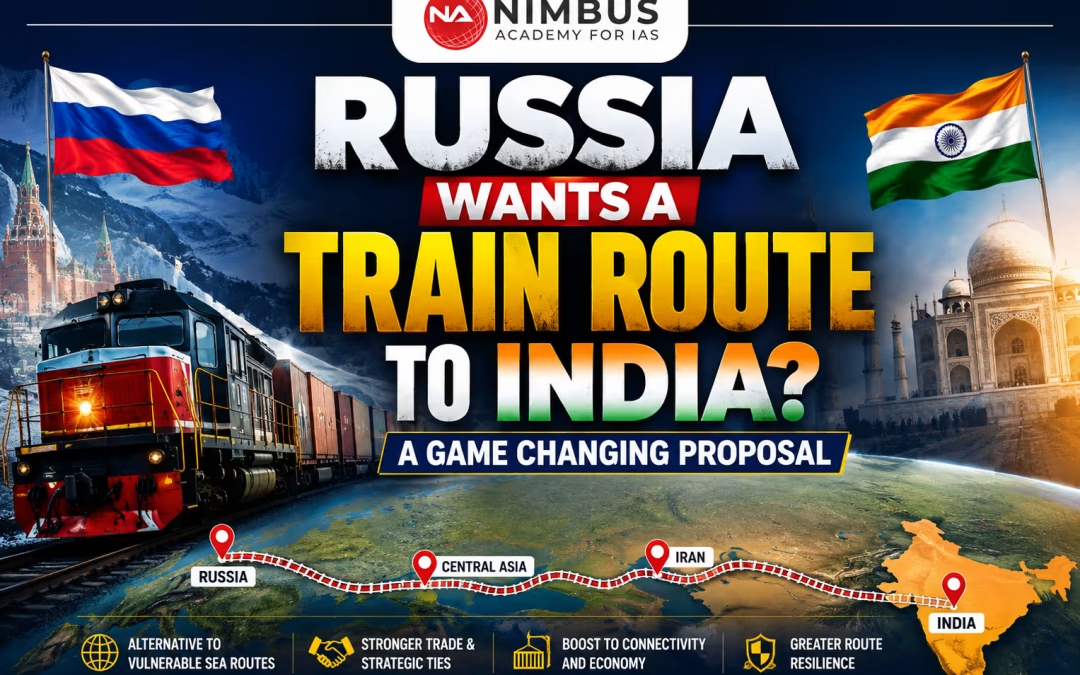
A proposal emerging from Moscow has put a surprising idea into the spotlight: could Russia eventually establish a direct rail connection toward India and the Indian Ocean?
The proposal is not about a new passenger train that is ready to start running between Moscow and New Delhi. Instead, it concerns the development and exploration of a land-based rail and transport corridor that could improve Russia’s access to the Indian Ocean and, potentially, India.
Russian Deputy Prime Minister Marat Khusnullin has argued that alternative routes should be explored to reduce dependence on vulnerable maritime passages. The idea has attracted attention because it combines trade, geography, geopolitics, infrastructure and India–Russia relations.
🚆 What exactly has Russia proposed?
The headline “Russia to India by train” sounds like a new international passenger service is about to begin. That is not what has been announced.
The proposal is about exploring a rail-based connection that could eventually give Russia overland access toward the Indian Ocean and India.
Khusnullin has spoken about developing transport links through Central Asia and Iran, with access to the Indian Ocean. Recent reporting has also discussed possible routes involving Afghanistan and Pakistan, but the exact alignment has not been finalized.
So, for now:
This is a strategic infrastructure proposal—not an operational Russia–India train.
That distinction is important when reporting the story.
🌍 Why does Russia want another route to India?
The biggest reason is trade-route security.
International trade depends heavily on maritime routes. When geopolitical tensions affect important waterways, ships can face delays, higher insurance costs, longer journeys and greater uncertainty.
Two strategically important chokepoints frequently mentioned in discussions around this proposal are:
- Bosphorus Strait
The Bosphorus connects the Black Sea with the Sea of Marmara and is an important gateway for maritime traffic involving the Black Sea region.
For Russia, access through the wider Black Sea–Mediterranean system can become strategically sensitive during periods of geopolitical tension.
- Strait of Hormuz
The Strait of Hormuz connects the Persian Gulf with the Gulf of Oman and the Arabian Sea.
It is one of the world’s most strategically important maritime chokepoints, particularly for energy shipments.
A disruption in this region can have consequences far beyond the Middle East.
Russia’s thinking is therefore broader than simply building another railway.
It is about creating more options.
🗺️ How could the route work?
The precise route is still subject to feasibility and political discussions, but the broad concept involves connecting Russia with Central Asia and onward toward Iran and the Indian Ocean.
A simplified conceptual map could look like:
Russia 🇷🇺
↓
Central Asia
↓
Iran 🇮🇷
↓
Indian Ocean 🌊
↓
India 🇮🇳
Some reports have discussed potential connections involving Turkmenistan, Iran, Afghanistan and Pakistan, but these should not be presented as a confirmed final route.
This is why the story is more complicated than saying:
“Russia is building a railway from Moscow to Delhi.”
It isn’t.
🇮🇳 Why is India important?
India is one of the world’s major economies and an increasingly important trading partner for Russia.
A stronger land-based connection could potentially facilitate the movement of:
- Energy products
- Machinery
- Industrial goods
- Agricultural commodities
- Fertilizers
- Metals
- Consumer products
- Other bulk cargo
The bigger objective would be to make Russia–India trade more resilient by giving businesses additional transportation options.
For India, stronger connectivity with Russia could also improve access to Central Asian and Eurasian markets.
🚢 The connection with the International North–South Transport Corridor
This is where the story becomes particularly important for UPSC and international relations.
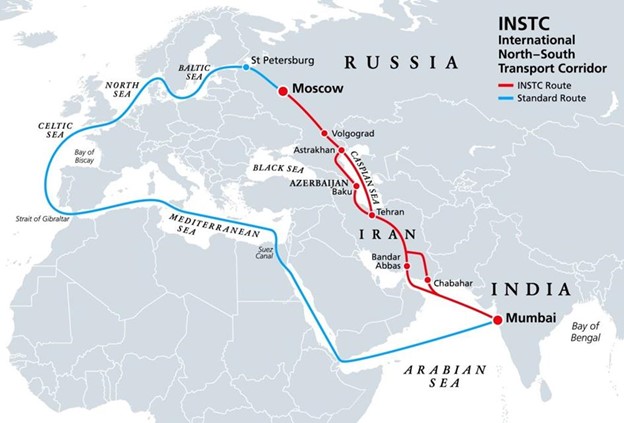
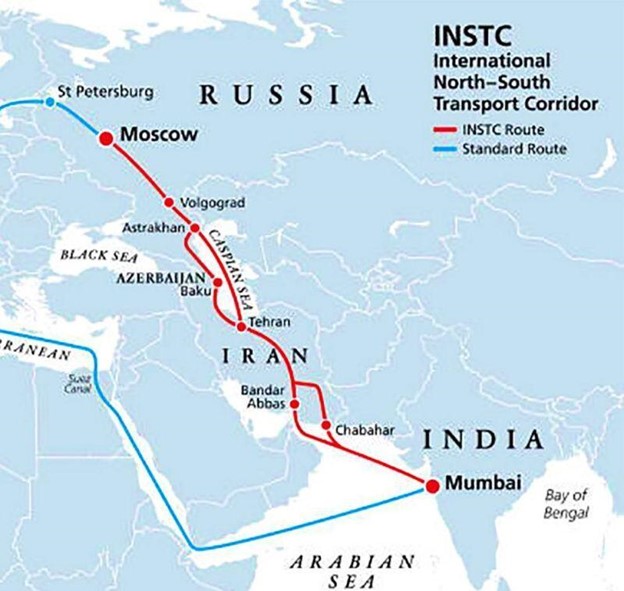
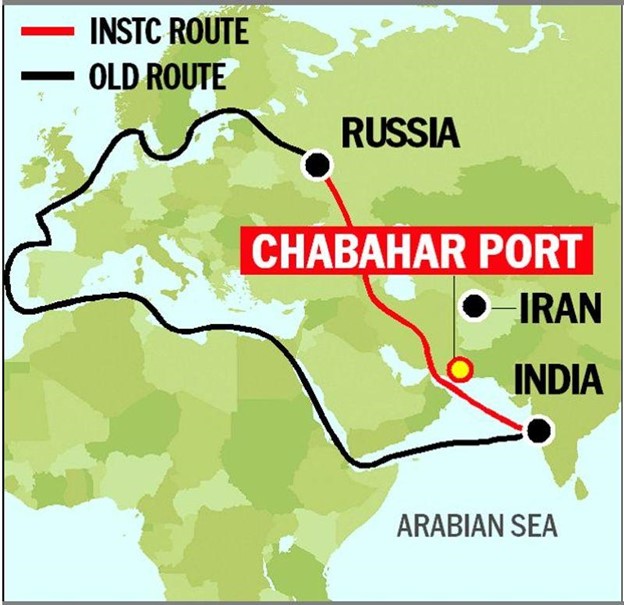
The proposed idea overlaps with the broader concept of the International North–South Transport Corridor (INSTC).
The INSTC is a multimodal transport network involving railways, roads and maritime links.
India, Russia and Iran were among its original founding participants. The objective is to create a more efficient transportation connection between India, Iran, Russia and onward markets.
India has also promoted the importance of Chabahar Port in Iran as a gateway toward Afghanistan and Central Asia. The Indian government has described the INSTC as a route connecting the Indian Ocean and Persian Gulf with the Caspian Sea and onward to Russia and Europe.
6
The key difference is that the INSTC is already an established multimodal corridor concept, whereas the newly discussed direct rail idea is a proposal to further develop land connectivity.
🚆 Why railways instead of ships?
Rail transport can offer several advantages for certain types of cargo.
Faster movement
For some land routes, rail can reduce transit times compared with long maritime journeys.
Greater route diversification
Instead of relying on one sea route, countries can use multiple transportation corridors.
Strategic resilience
If a maritime chokepoint becomes disrupted, alternative land routes can become valuable.
Regional integration
A railway connecting Russia with Central and South Asia could increase trade opportunities for countries along the route.
However, railways aren’t automatically cheaper or easier.
A huge international rail corridor requires tracks, border crossings, customs infrastructure, compatible railway systems, security arrangements and political cooperation across multiple countries.
⚠️ The biggest challenge: Geography and geopolitics
This is where the proposal faces its toughest questions.
A Russia–India land connection would potentially have to cross or connect through some extremely complicated geopolitical environments.
The possible corridors involve countries such as:
- Kazakhstan
- Turkmenistan
- Iran
- Afghanistan
- Pakistan
- India
Each country has its own infrastructure, security conditions, border procedures and political interests.
And the moment a route involves Afghanistan or Pakistan, the complexity increases significantly.
That means constructing tracks isn’t the only challenge.
The countries would need agreements covering:
Transit rights → Customs → Security → Border management → Railway standards → Freight tariffs → Investment → Political stability
🇵🇰 Why Pakistan could become important
Some reporting on the proposal has discussed a possible route through Pakistan.
That would be strategically significant because Pakistan sits geographically between Iran and India.
But a Russia–India rail corridor passing through Pakistan would require substantial political coordination between India and Pakistan, in addition to agreements involving Russia and other transit states.
Therefore, this should be treated as a possible route discussed in reporting—not an agreed corridor.
🇮🇷 Why Iran is strategically important
Iran could become one of the most important pieces of the puzzle.
Iran provides Russia with a potential land connection toward the Persian Gulf and Indian Ocean, while also connecting to India’s existing interests around Chabahar.
This creates a potentially powerful triangle:
Russia 🇷🇺 ↔ Iran 🇮🇷 ↔ India 🇮🇳
The three countries have already been associated with the INSTC since 2000, making the current discussion part of a much longer effort to improve Eurasian connectivity.
🌊 Why the Indian Ocean matters to Russia
Russia is geographically dominated by the Eurasian landmass and has access to several seas, but its maritime connectivity is affected by geography and strategic chokepoints.
A route reaching the Indian Ocean would have enormous economic significance.
The Indian Ocean connects some of the world’s most important commercial regions:
East Africa ↔ Middle East ↔ India ↔ Southeast Asia ↔ East Asia
For Russia, greater access to this network could provide another channel for international trade.
This is particularly relevant as Moscow seeks to diversify its trade relationships and transportation networks.
🇮🇳 What could India gain?
India could potentially benefit in several ways.
- Better access to Russian markets
Improved land connectivity could make certain categories of India–Russia trade easier.
- Access to Central Asia
India has long sought better connectivity with Central Asian countries.
Geography makes direct connectivity difficult, and Pakistan’s position has historically complicated overland access.
- Strategic importance of Chabahar
Improved connectivity through Iran could strengthen India’s broader strategy around Chabahar Port.
- More trade-route options
India benefits when it has multiple options for reaching Eurasian markets rather than depending on a single route.
💰 Could this change India–Russia trade?
Potentially—but not immediately.
Infrastructure projects of this scale take years, sometimes decades, to develop.
If a workable corridor eventually emerges, it could reduce logistical friction for certain categories of cargo and improve the reliability of supply chains.
But the actual economic benefits would depend on:
- Construction costs
- Transit fees
- Border delays
- Railway capacity
- Security
- Sanctions
- Insurance costs
- Customs procedures
- Political stability
- Demand from businesses
So it would be premature to claim that the proposed railway will automatically transform India–Russia trade.
🌐 The bigger geopolitical picture
The proposal reflects a much larger trend in international politics:
Countries are increasingly trying to diversify their trade routes.
For decades, global trade relied heavily on major maritime corridors.
But geopolitical tensions, wars, sanctions and disruptions have shown that transportation routes can become strategic vulnerabilities.
That has encouraged countries to invest in alternative corridors.
Examples include:
- INSTC
- India–Middle East–Europe Economic Corridor
- China’s Belt and Road Initiative
- Middle Corridor
- Various Arctic and Eurasian transport routes
Russia’s proposed India connection fits into this broader competition over Eurasian connectivity.
🇨🇳 What about China?
China is another important factor.
China has spent years developing railways, highways, ports and logistics infrastructure across Eurasia through the Belt and Road Initiative.
A stronger Russia–Central Asia–Iran–India connectivity network could create another major transportation architecture across the continent.
For India, this is strategically relevant because connectivity isn’t just about economics.
It can influence:
Trade → Energy → Diplomacy → Strategic influence → Regional integration
🚨 But don’t call it a “Russia–India train” yet
This is the most important point for anyone making a news post about the story.
❌ Misleading:
“Russia has started a direct train to India.”
❌ Also misleading:
“Russia is building a Moscow–Delhi railway.”
✅ More accurate:
“Russia has proposed exploring a rail connection toward India and the Indian Ocean.”
✅ Even better:
“Russia is exploring new rail connectivity to the Indian Ocean and potentially India as an alternative to vulnerable maritime routes.”
The proposal is still at the exploration/feasibility stage, and no definitive final route has been announced.
📌 Why this matters for UPSC/HPAS
This one story can connect to multiple syllabus areas.
Geography
- Indian Ocean
- Eurasian geography
- Strategic chokepoints
- Central Asia
- Transport corridors
International Relations
- India–Russia relations
- India–Iran relations
- Central Asia
- Regional connectivity
Economy
- International trade
- Logistics
- Supply chains
- Transport costs
Infrastructure
- Railway corridors
- Multimodal transport
- Ports
- Cross-border connectivity
Strategic Affairs
- Maritime chokepoints
- Energy security
- Trade-route resilience
Important terms to remember
INSTC — International North–South Transport Corridor
Chabahar Port — Iran
Strait of Hormuz — Persian Gulf ↔ Gulf of Oman
Bosphorus Strait — Black Sea ↔ Sea of Marmara
Indian Ocean — Major global trade and energy corridor