
Indian Society in Transition: Preserving Unity Amid Growing Diversity
GS-1, Unit-3, Sub Unit-1, HPAS Mains
Indian society has always been marked by extraordinary diversity—of languages, religions, ethnicities, castes, regions and cultural practices. What makes India unique, however, is not merely this diversity but its civilisational ability to sustain unity within it. In the contemporary period, Indian society is undergoing a profound transition driven by globalisation, urbanisation, technological change and shifting social aspirations. These transformations have expanded diversity in new ways while simultaneously posing fresh challenges to social cohesion. Preserving unity amid this growing diversity has therefore become one of the central tasks of modern India.
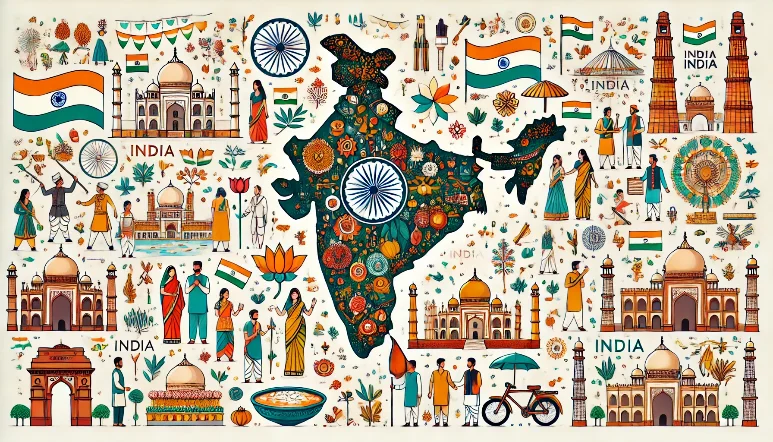
Historical Foundations of Unity in Diversity
The idea of unity in diversity is not a modern construct imposed after independence; rather, it is deeply rooted in India’s civilisational past. Ancient India accommodated multiple philosophical traditions—Vedic, Buddhist, Jain and materialist schools—without enforcing a single worldview. Medieval India witnessed the interaction of diverse cultures through Bhakti and Sufi movements, which emphasised social harmony and spiritual equality. During the freedom struggle, leaders like Gandhi, Nehru and Ambedkar consciously transformed this civilisational pluralism into a political ideal, making unity in diversity the moral basis of the Indian nation-state.
The Indian Constitution institutionalised this principle by guaranteeing fundamental rights, cultural autonomy to minorities, linguistic reorganisation of states and a secular framework. Thus, unity in India has never meant uniformity; it has meant coexistence with mutual respect.
Forces Driving Transition in Indian Society
Post-independence India has entered a phase of rapid social transformation. Urbanisation and internal migration have brought people from diverse backgrounds into close daily interaction, especially in metropolitan cities. Globalisation has exposed Indian society to global ideas, lifestyles and consumption patterns, adding new layers of cultural diversity. Education, digital media and social networks have reshaped identities, particularly among youth, enabling individuals to assert regional, caste, gender and religious identities more strongly.
At the same time, traditional social hierarchies are being challenged. The rise of social mobility, empowerment of historically marginalised groups and increasing participation of women in public life indicate positive change. However, these transitions also generate social anxieties, as old structures weaken and new norms are yet to stabilise.
Emerging Challenges to Social Unity
While diversity has expanded, unity has become more fragile. Identity-based assertions, though often rooted in legitimate demands for recognition and justice, sometimes slip into exclusivism and polarisation. Caste, religion, language and region are increasingly mobilised in competitive political and social spaces, occasionally undermining collective national identity.
Economic inequalities further complicate this picture. Uneven development, regional disparities and unequal access to opportunities can convert cultural differences into sources of conflict. Digital media, while democratising expression, has also accelerated the spread of misinformation, stereotypes and hate narratives, intensifying social divisions.
Moreover, the transition from community-based societies to more individualistic urban settings has weakened traditional mechanisms of social integration such as kinship networks and local institutions, creating a sense of alienation among sections of the population.
Institutions and Values Sustaining Unity
Despite these challenges, Indian society continues to display remarkable resilience. Constitutional values—justice, liberty, equality and fraternity—remain the strongest binding force. Democratic institutions, though imperfect, provide peaceful avenues for negotiation, dissent and accommodation of diverse interests.
India’s federal structure allows regional identities to flourish without threatening national unity. The recognition of multiple languages, cultures and traditions within a single political framework has prevented the dominance of any single identity. Educational institutions, civil society organisations and the judiciary also play a crucial role in reinforcing social harmony and constitutional morality.
Equally important are India’s shared cultural practices—festivals, food traditions, popular culture and everyday social interactions—that cut across rigid identities and create informal bonds of unity.
Way Forward: Strengthening Unity in a Diverse Society
Preserving unity in a transitioning society requires moving beyond symbolic celebration of diversity to active management of diversity. Inclusive development that reduces economic and regional inequalities is essential to prevent social fragmentation. Education must promote constitutional values, critical thinking and empathy, enabling citizens to appreciate diversity without fear.
Political leadership carries a special responsibility to avoid divisive rhetoric and instead emphasise common civic identity over narrow affiliations. Strengthening local governance and community-level dialogue can help rebuild trust and social cohesion in an increasingly mobile and urbanised society.
Conclusion
Indian society stands at a critical juncture where diversity is expanding in form, expression and intensity. The challenge is not diversity itself, but the ability to preserve unity without suppressing difference. India’s historical experience, constitutional framework and democratic ethos provide strong foundations to meet this challenge. If managed with wisdom, inclusion and justice, India’s transition can reaffirm unity in diversity not merely as a slogan, but as a living social reality.