
Significant Provisions including Fundamental Rights, Directive Principles of State Policy, Fundamental Duties
Fundamental Rights vs Directive Principles: Harmony or Tension?
GS-2, Unit-1, Sub Unit-1, HPAS Mains
The Indian Constitution is often described as a carefully balanced document that combines liberty with social justice. At the heart of this balance lie two powerful sets of provisions: Fundamental Rights (Part III) and the Directive Principles of State Policy (Part IV). While Fundamental Rights guarantee individual freedoms and protections against state action, Directive Principles guide the government in building a just and welfare-oriented society. Over the years, scholars, courts, and policymakers have debated whether these two parts exist in harmony — or in tension. The answer is nuanced: they have clashed at times, but ultimately, they are designed to complement each other.
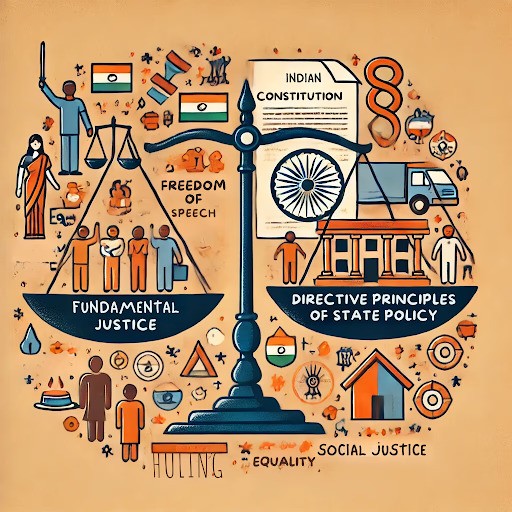
Let us explore how.
Understanding Fundamental Rights
Fundamental Rights are enforceable legal guarantees given to citizens (and in some cases, non-citizens) against arbitrary state action. They include:
- Right to Equality
- Right to Freedom
- Right against Exploitation
- Right to Freedom of Religion
- Cultural and Educational Rights
- Right to Constitutional Remedies
These rights are justiciable, meaning citizens can directly approach the courts if they are violated. Dr. B.R. Ambedkar called the Right to Constitutional Remedies the “heart and soul” of the Constitution for this reason.
Fundamental Rights are primarily concerned with individual liberty, dignity, and protection from state excess.
Understanding Directive Principles of State Policy (DPSP)
Directive Principles, on the other hand, are guidelines for the State to follow while making laws and policies. They aim to establish:
- Social and economic justice
- Equal pay for equal work
- Protection of workers
- Promotion of education
- Public health
- Environmental protection
- Organization of village panchayats
- Reduction of inequality
Unlike Fundamental Rights, DPSPs are non-justiciable — courts cannot force the government to implement them. However, they are declared to be “fundamental in the governance of the country.”
They focus not on individual liberty alone, but on collective welfare and social transformation.
The Source of Tension
The tension arises because sometimes implementing Directive Principles requires restricting Fundamental Rights.
For example:
- Land reform laws aimed at reducing inequality (a DPSP goal) required the government to limit the right to property (previously a Fundamental Right).
- Policies for social justice, reservations, and redistribution may affect equality claims.
- Regulations for labour welfare may affect freedom of trade or profession.
In such cases, the question emerges: Which should prevail — individual rights or social welfare goals?
Early Judicial Approach: Fundamental Rights Prevail
In the early years after independence, the Supreme Court gave greater importance to Fundamental Rights.
In the Champakam Dorairajan case (1951), the Court ruled that if a law made to implement Directive Principles violates Fundamental Rights, it would be invalid. The judgment clearly stated that Fundamental Rights are superior.
This created a constitutional challenge because many welfare and reform laws were based on Directive Principles. To overcome this obstacle, Parliament introduced constitutional amendments — including adding protective provisions like Article 31C (later modified).
This period showed clear institutional tension between Parts III and IV.
Shift Toward Balance: The Harmony Doctrine
Over time, the Supreme Court’s thinking evolved. Instead of viewing Rights and Directive Principles as rivals, the Court began to see them as complementary.
A landmark moment came with the Kesavananda Bharati case (1973). The Court introduced the Basic Structure Doctrine and emphasized that both Fundamental Rights and Directive Principles are essential parts of the constitutional framework. Neither should destroy the other.
Later, in the Minerva Mills case (1980), the Court clearly stated:
The Constitution is founded on the balance between Fundamental Rights and Directive Principles — giving absolute primacy to one over the other would damage the basic structure.
This marked a turning point — from confrontation to constitutional harmony.
How Harmony Works in Practice
In modern constitutional interpretation, courts often interpret Fundamental Rights in the light of Directive Principles.
Examples include:
- Right to Education — once a Directive Principle (Article 45), later became a Fundamental Right (Article 21A).
- Right to Livelihood — read into Article 21 (Right to Life) using DPSP guidance.
- Environmental protection — DPSP provisions helped courts expand the Right to Life to include a clean environment.
- Legal aid and speedy justice — inspired by Directive Principles and recognized under Fundamental Rights.
Thus, DPSPs have increasingly influenced the expansion of rights, rather than merely conflicting with them.
Philosophical Difference: Liberty vs Equality
At a deeper level, the tension reflects a philosophical difference:
- Fundamental Rights focus on liberty — protecting the individual from state interference.
- Directive Principles focus on equality and welfare — asking the state to actively intervene to reduce injustice.
Modern constitutionalism recognizes that liberty without social justice is incomplete, and social justice without liberty can become oppressive. The Indian Constitution attempts to blend both traditions — liberal and social-democratic.
Present-Day View: Complement, Not Conflict
Today, the dominant constitutional view is that Fundamental Rights and Directive Principles are mutually reinforcing:
- Rights provide the legal tools
- Directive Principles provide the policy direction
- Together they shape a welfare democracy
Courts now prefer interpretations that allow both to operate together wherever possible.
Rather than asking which is superior, constitutional practice asks:
How can both be advanced together?
Conclusion
The relationship between Fundamental Rights and Directive Principles began with tension but matured into harmony. Early conflicts were natural in a newly independent nation attempting both to protect liberty and to transform society. Through judicial interpretation and constitutional evolution, India has moved toward a model where rights and welfare goals support each other.
Fundamental Rights ensure that the State does not become unjust. Directive Principles ensure that the State does not become indifferent.
Together, they form the moral and legal compass of Indian democracy — balancing freedom with fairness, and liberty with justice.
Note: Topic important for IAS Exam Preparation, HPAS, State PCS