
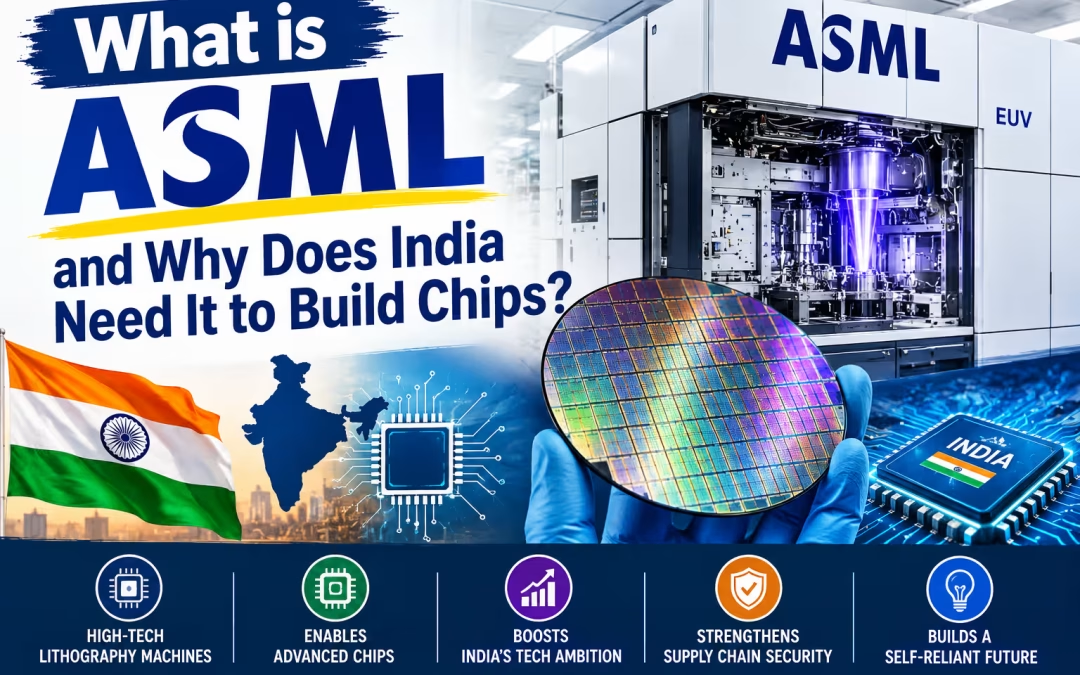
Your phone, your laptop, your car, your smartwatch – all of them work because of tiny chips inside them. These chips are so small that thousands of them can fit on your fingernail. But making these chips requires one special machine. And that machine is made by only one company in the entire world. That company is ASML. This week, ASML officially started operations in India. Let us understand why this matters so much.
🔬 What is a Semiconductor Chip?
A semiconductor chip is a tiny piece of silicon that acts like a brain for electronic devices. Every time you tap your phone screen, press a key on your laptop, or start your car, billions of tiny signals pass through these chips in a fraction of a second.
Without chips, modern life simply stops. No smartphones. No computers. No electric vehicles. No fighter jets. No ATMs. No internet. Chips run everything around us.
Think of a chip like a city map drawn on a grain of rice. The roads are circuits. The buildings are transistors. The whole map has to be perfectly drawn – or nothing works. Making chips is basically drawing a perfect city map on something smaller than a grain of rice, millions of times over.
🏭 How Are Chips Made?
Chips are made in giant factories called semiconductor fabs (fabrication plants). Inside these fabs, engineers take a round disc of purified silicon called a wafer. They then print millions of tiny circuit patterns on this wafer using a process called lithography.
Lithography is like using light to stamp a pattern onto silicon – the same way you use a rubber stamp on paper, but billions of times more precise. The light has to be so accurate that even a tiny error of a few atoms can destroy the entire chip.
This is where ASML comes in.
🌍 So What Exactly is ASML?
ASML is a Dutch company headquartered in Veldhoven, Netherlands. Its full name is Advanced Semiconductor Materials Lithography. It makes the machines that do the lithography process – printing circuit patterns onto silicon wafers.
ASML has a near-complete monopoly on advanced lithography machines. No advanced chip in the world today – not by Samsung, not by TSMC, not by Intel – can be made without an ASML machine. It is the most critical single company in the global technology supply chain.
ASML’s most advanced machines are called EUV (Extreme Ultraviolet) lithography machines. Each machine costs around Rs 1,500 crore (about 180 million dollars). Only ASML can make them. It takes years to build one machine. And there is always a waiting list.
🇮🇳 Why Did ASML Come to India?
India is building its first serious semiconductor chip manufacturing facility. And ASML just started operations in India in September 2026, right after SEMICON India 2026 was held in Noida.
ASML Executive Vice President Lin Kiat Yap confirmed at SEMICON India 2026 that the company has already set up a legal entity in India and is hiring its first team of 20 to 30 young Indian engineering graduates.
The reason ASML came to India is directly linked to one big project – the Tata Electronics chip fab in Dholera, Gujarat.
🏗️ What is the Tata Dholera Chip Factory?
Tata Electronics is building India’s first 300-mm semiconductor fabrication plant in Dholera, a special investment region in Gujarat. This is a massive project with an investment of over Rs 1 lakh crore (about 11 billion dollars).
Investment: Rs 1.18 lakh crore (about $11 billion)
Capacity: 50,000 wafers per month
Commercial operations: Expected mid-2028
Location: Dholera Special Investment Region, Gujarat
Chip types: Automotive, mobile devices, artificial intelligence applications
Tata Electronics and ASML signed a strategic partnership in May 2026. Under this deal, ASML will supply lithography equipment and provide technical support to help Tata’s factory run smoothly. Tata is also ASML’s first customer in India to set up a 300-mm wafer fab.
On top of this, Tata has already signed 16 agreements with vendors and is building a 363-acre vendor park in Dholera to house around 450 supply chain companies that will support the fab.
🏛️ What is India’s Semiconductor Mission? Know for UPSC
India’s journey to become a chip-making nation is backed by a big government program. Here are the key things you need to know:
India Semiconductor Mission (ISM):
Launched in 2021 under the Ministry of Electronics and IT (MeitY), this mission aims to develop a full semiconductor and display manufacturing ecosystem in India. It provides financial support, infrastructure, and policy backing to chip makers setting up factories in India.
Semicon 2.0 Scheme:
The government notified an upgraded Semicon 2.0 scheme in August 2026 with a total financial outlay of Rs 1.27 lakh crore (about $13.5 billion). Union Minister Ashwini Vaishnaw confirmed that India has already secured about $12 billion in investment commitments under this scheme.
India’s Chip Targets:
- Produce 15 to 25% of India’s local semiconductor demand domestically by 2032
- Scale up to 35 to 50% of local demand by 2035
- This will require building around a dozen large chip factories across the country
India currently imports nearly 100% of its semiconductor chips. The total global semiconductor market is worth about $600 billion per year. India’s domestic chip market alone is expected to cross $100 billion by 2030. Making chips in India is not just about technology – it is about national security, economic independence, and creating high-skill jobs.
💡 Why Does India Need to Make Its Own Chips?
National Security:
Modern defence systems – missiles, fighter jets, radar, satellites – all run on chips. If India depends entirely on other countries for chips, it is a serious national security risk. What if a country stops supplying chips during a conflict?
Economic Independence:
India spends billions of dollars every year importing chips. Building domestic chip manufacturing will save foreign exchange, reduce the trade deficit, and create hundreds of thousands of high-paying jobs.
Lessons from the COVID Chip Shortage:
During COVID-19, a global chip shortage caused car production to stop, phone prices to shoot up, and electronics to go out of stock everywhere. Countries with their own chip factories – like Taiwan, South Korea, and the USA – managed better. India had no chips of its own and suffered badly.
China Factor:
Taiwan produces about 60% of the world’s chips and over 90% of the most advanced chips. If China ever blockades Taiwan, the entire global tech industry collapses. India building its own chip capacity is part of a global effort to reduce this dangerous dependency.
🌐 Who Else is Coming to India for Chips?
ASML is not alone. Several global semiconductor giants showed up at SEMICON India 2026 and are expanding in India:
- Applied Materials – world’s largest supplier of chip manufacturing equipment, expanding India presence
- Lam Research – major chip equipment maker, setting up in India
- Micron Technology – building a semiconductor assembly and test facility in Sanand, Gujarat
- L&T Semiconductor Technologies – Indian company announcing commercial chip production plans
- Kaynes Technology – Indian electronics maker entering chip packaging
India is also seeing its own domestic chip design companies grow rapidly. Companies like IndieSemiC, Axiro, and Aheesa Digital Innovations have announced plans for chip design and production in 2026.
📍 Where is Dholera and Why Was It Chosen?
Dholera is a greenfield smart city being built from scratch in Gujarat, about 100 km from Ahmedabad. It is part of the Delhi-Mumbai Industrial Corridor (DMIC) project.
Dholera was chosen for India’s first big chip factory because it has dedicated industrial land, planned infrastructure, 24/7 power supply arrangements, water availability, and direct connectivity to ports. Chip factories need an absolutely stable power supply – even a one-second power cut can destroy an entire batch of chips being processed.
📝 Quick Recap – Remember for UPSC
- ASML is a Dutch company that makes lithography machines – the only machines that can print circuit patterns on chips. No chip in the world is made without ASML equipment.
- ASML started operations in India in September 2026, set up a legal entity, and is hiring 20 to 30 engineering graduates initially.
- ASML’s first Indian customer is Tata Electronics, which is building a Rs 1.18 lakh crore chip factory in Dholera, Gujarat. Production starts in 2028.
- India’s Semicon 2.0 scheme has a budget of Rs 1.27 lakh crore ($13.5 billion) to build India’s chip manufacturing ecosystem.
- India’s target: meet 15 to 25% of local chip demand domestically by 2032 and 35 to 50% by 2035.
- Key ministry: Ministry of Electronics and IT (MeitY) under Minister Ashwini Vaishnaw.
- Why it matters: national security, economic independence, reducing import bills, and high-skill job creation.
Looking for the best IAS Coaching in Chandigarh? Join Nimbus Academy and get expert guidance for UPSC preparation.
Want to master Science and Technology and Economy topics for UPSC? Join Nimbus Academy’s expert-led programs.