
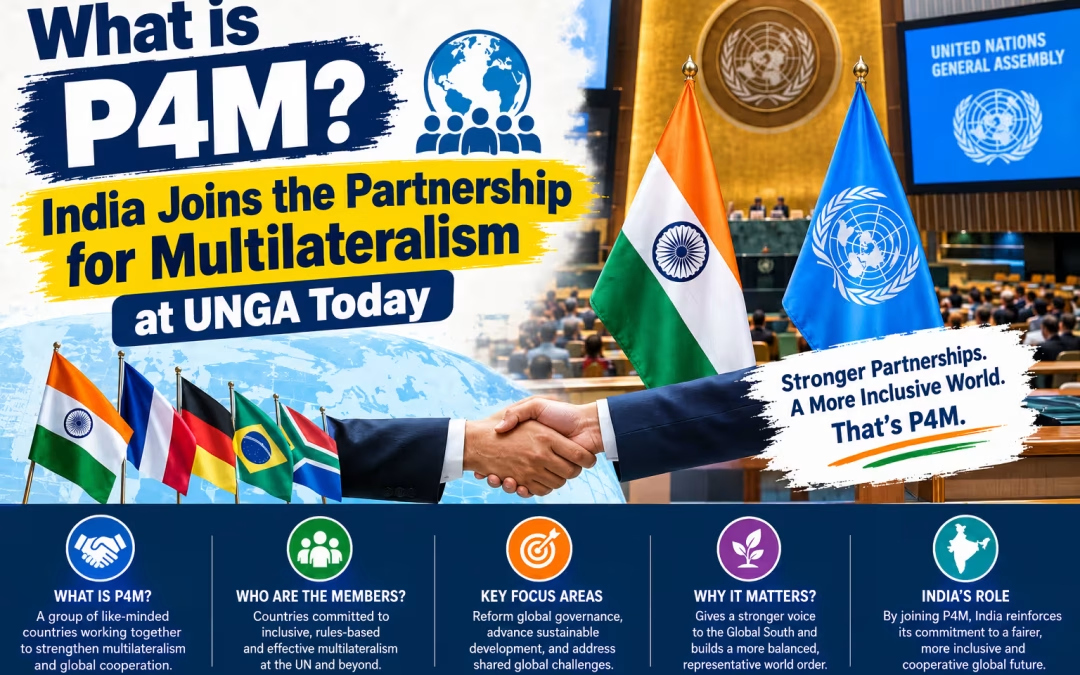
On September 21, 2026, India made a quiet but very important decision in New York. At the sidelines of the United Nations General Assembly, External Affairs Minister S. Jaishankar co-chaired the first-ever summit of a brand new global grouping called P4M. India is now a founding co-sponsor of this group. Let us understand what P4M is, why it was created, and why this matters for India and for UPSC.
🌐 First, What is the United Nations General Assembly (UNGA)?
The United Nations has 193 member countries. Every year in September, all these countries send their leaders and foreign ministers to New York for a big meeting called the UN General Assembly (UNGA). It is like the world’s largest annual meeting.
This year, the 81st session of UNGA is underway from September 18 to 28, 2026. India’s External Affairs Minister S. Jaishankar is leading India’s delegation this week and will deliver India’s national address at UNGA on September 26, 2026.
Think of UNGA like a giant school assembly where every country in the world gets to stand up and speak about the problems they face and the solutions they want. No country is forced to agree, but the conversations shape global policy. P4M is a new group of students in that assembly who have decided to sit together and speak with one voice.
🤝 So What Exactly is P4M?
P4M stands for Partners for Multilateralism, International Law, Peace and Prosperity. It is a brand new diplomatic grouping launched on September 21, 2026 on the sidelines of UNGA in New York.
Full name: Partners for Multilateralism, International Law, Peace and Prosperity
Launched: September 21, 2026 at the UNGA High-Level Week, New York
Founded by: European Union, Brazil, Canada, and Kenya
Initial co-sponsors: India, Australia, and Barbados
India’s representative: External Affairs Minister S. Jaishankar
The grouping describes itself as a non-superpower coalition. It brings together mid-sized countries, regional blocs, and developing nations who want to reform how global decisions are made – outside the traditional battles between big superpowers like the USA, China, and Russia.
🔍 Why Was P4M Created? The Problem It Is Trying to Solve
The world today is increasingly divided. The USA and China are competing with each other. Russia and Ukraine are at war. Trade is being used as a weapon. Countries are forming rival blocs. And the United Nations – which was created to solve all these problems – is getting paralysed.
The UN Security Council, which is supposed to maintain global peace, has five permanent members – USA, China, Russia, UK, and France. Any one of them can veto any decision they do not like. This has made the Security Council almost useless in solving recent conflicts.
In this situation, many mid-sized countries felt left out. They were not powerful enough to dominate global decisions, but too important to just stay silent. P4M was born to give these countries a united platform.
Imagine a class where two very strong students control everything. Other students who are smart and capable get ignored. So 7 of those ignored students form a study group to work together and make sure their voices are heard. That is exactly what P4M is doing at the global level.
📋 What Does P4M Stand For? Its 5 Core Goals
1. Strengthen the United Nations and Multilateral Institutions:
P4M wants to reform global bodies like the UN so they are more representative, effective, and trusted. This includes pushing for UN Security Council reform – a long-standing demand of India.
2. Uphold International Law:
The declaration warns that growing conflicts, protectionism, and use of economic coercion are threatening international law. P4M commits all members to respecting international law and human rights.
3. Fight the Global 4F Crisis:
Jaishankar specifically highlighted what he called the “Global 4F Crisis” – disruptions in Food, Fuel, Fertiliser, and Finance. These four issues are hurting developing countries the most and P4M wants collective action on all four.
4. Tackle Global Challenges Together:
Climate change, Artificial Intelligence governance, global health, supply chain resilience, and digital transformation – P4M believes these problems are too big for any one country to handle alone.
5. Reduce Dependence on Rival Power Blocs:
P4M gives smaller countries a platform to avoid being forced to choose sides between the USA and China. It is about building a third space in global politics.
🇮🇳 Why Did India Join P4M?
India’s Voice for the Global South:
India has positioned itself as the leader of the Global South – the group of developing and emerging economies. P4M aligns perfectly with this identity. By joining, India signals that it wants a fairer and more inclusive global order.
Fits India’s Strategic Autonomy:
India has always followed a policy of strategic autonomy – not fully aligning with either the USA or Russia or China. P4M is built on exactly this philosophy. It is a non-superpower coalition, which suits India’s independent foreign policy tradition perfectly.
UNSC Permanent Membership Campaign:
Jaishankar is also at UNGA this week to garner support for India’s bid for permanent membership of the UN Security Council for the 2028-2029 period. Being a founding co-sponsor of P4M – a group that openly calls for UNSC reform – directly supports this campaign.
Carney Doctrine Connection:
P4M was built upon Canadian Prime Minister Mark Carney’s “Carney Doctrine” on middle-power solidarity, first delivered at Davos 2026. India joining this shows it sees itself as a leading middle power with a responsibility to shape global rules.
🌍 Who Are the Other P4M Members?
- European Union – the founding initiator, 27 nations speaking with one voice
- Brazil – South America’s largest economy and a G20 member
- Canada – whose PM Mark Carney first proposed the “middle power solidarity” idea
- Kenya – representing Africa’s voice in global governance
- Australia – India’s Quad partner, co-sponsor along with India
- Barbados – representing small island developing states
- India – the largest democracy and voice of the Global South
The P4M declaration also stated that the grouping remains open to new partners from all regions of the world. More countries are expected to join in the coming months.
📖 What is Multilateralism? Know This for UPSC
Multilateralism simply means countries working together through international institutions and rules rather than acting alone or through bilateral deals. The United Nations, the World Trade Organization, and the Paris Climate Agreement are all examples of multilateralism at work.
The opposite of multilateralism is unilateralism – when a powerful country acts alone based on its own interests regardless of what others think. The USA under certain administrations and China’s Belt and Road Initiative have sometimes been criticized as examples of unilateral approaches.
The term “reformed multilateralism” is very important for GS Paper 2. India has always called for reforms in institutions like the UN, IMF, and WTO to give more voice to developing countries. P4M is the newest expression of this long-standing Indian foreign policy position.
🏛️ How Does P4M Connect to India’s Other Foreign Policy Initiatives?
BRICS: India is a founding member of BRICS (Brazil, Russia, India, China, South Africa). BRICS also talks about reforming global institutions but is now dominated by China and Russia. P4M gives India a Western-aligned platform to push the same reforms without China’s dominance.
G20 Presidency: India held the G20 Presidency in 2023 and made the Global South’s voice its central theme. P4M continues that same message on a different stage.
Quad: The Quad (India, USA, Japan, Australia) focuses mainly on Indo-Pacific security. P4M is different – it focuses on broader global governance reform and is more inclusive of developing nations.
Together, these memberships show India’s strategy of being present in multiple global platforms without fully committing to any single bloc. This is strategic autonomy in action.
📝 Quick Recap – Remember for UPSC
- P4M = Partners for Multilateralism, International Law, Peace and Prosperity. Launched on September 21, 2026 at UNGA in New York.
- Founded by EU, Brazil, Canada, and Kenya. India joined as an initial co-sponsor along with Australia and Barbados.
- It is a non-superpower coalition of mid-sized powers seeking to reform global institutions outside the US-China rivalry.
- India’s EAM S. Jaishankar co-chaired the inaugural summit alongside European Council President Antonio Costa.
- 5 core goals: UN reform, uphold international law, fight 4F crisis (Food, Fuel, Fertiliser, Finance), tackle climate and AI, reduce dependence on rival blocs.
- Fits India’s policy of Strategic Autonomy and its role as voice of the Global South.
- Connected to India’s campaign for a permanent UNSC seat for the 2028-2029 term.
- Jaishankar will deliver India’s national address at UNGA on September 26, 2026.
Looking for the best IAS Coaching in Chandigarh? Join Nimbus Academy and get expert guidance for UPSC preparation.
Want to master International Relations and Global Governance for UPSC? Join Nimbus Academy’s expert-led programs.