
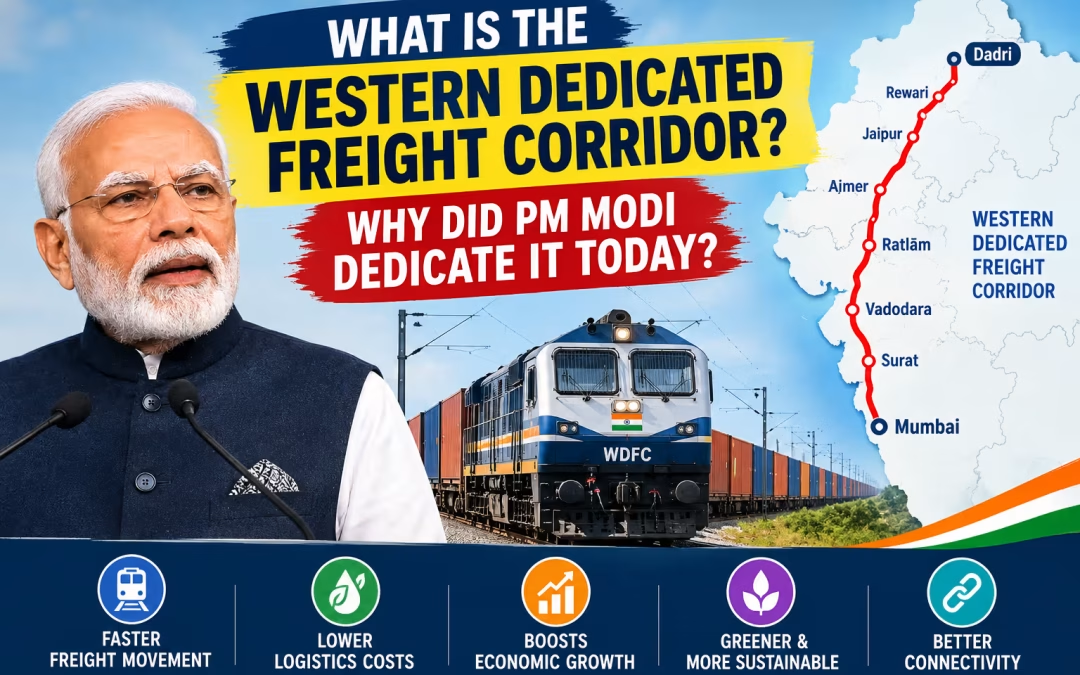
Imagine you order something online from Mumbai. The goods have to travel by train to Delhi. But the same track is also used by passenger trains – so the freight train keeps stopping and waiting. A journey that should take 1 day ends up taking 4 or 5 days. This has been India’s railway problem for decades. The Western Dedicated Freight Corridor is India’s answer to this problem. And on September 8, 2026, PM Modi completed it. Let us understand everything about it simply.
🚂 What is a Dedicated Freight Corridor?
In India, the same railway tracks are used by both passenger trains and goods trains. Passenger trains always get priority. So goods trains have to stop and wait for passenger trains to pass first.
This makes the movement of goods very slow and expensive. A Dedicated Freight Corridor (DFC) is a separate railway track built only for goods trains. No passenger trains use it. So goods trains can run faster, longer, and without stopping unnecessarily.
🗺️ What is the Western Dedicated Freight Corridor?
India has two main Dedicated Freight Corridors. One is the Eastern DFC and the other is the Western DFC. The Western Dedicated Freight Corridor (WDFC) connects two major points:
- Starting Point: Dadri in Uttar Pradesh (near Delhi – India’s major industrial area)
- Ending Point: JNPT (Jawaharlal Nehru Port Terminal) in Mumbai, Maharashtra
The total length of the Western Dedicated Freight Corridor. It passes through Uttar Pradesh, Haryana, Rajasthan, Gujarat, and Maharashtra – connecting India’s heartland to its biggest port.
JNPT in Mumbai is India’s largest container port. It handles around 55 to 60% of India’s total container traffic. Connecting it directly to industrial zones in the north and west via a fast freight corridor is a massive boost for India’s trade and exports.
📅 What Did PM Modi Do on September 8, 2026?
The idea of a Dedicated Freight Corridor was first conceived in 2004. A special company called Dedicated Freight Corridor Corporation of India (DFCCIL) was set up in 2006 to build it. But for years the project moved very slowly.
On September 8, 2026, PM Modi came to Vadodara in Gujarat and dedicated the final three remaining sections of the WDFC to the nation. With this, the full 1,506 km of the Western DFC became operational for the first time.
1. New Sanand (North) to New Makarpura
2. New Umbergaon to New Saphale
3. New Saphale to New JNPT (Mumbai)Total length: 326 route km. Total cost: more than Rs 20,700 crore.
PM Modi also flagged off freight train services from four new stations – New Sanand (North), New Makarpura, New Umbergaon, and New JNPT. The total projects dedicated in Vadodara on this single day were worth more than Rs 35,000 crore.
🔍 Why is This Important? 5 Big Benefits
🚀 1. Goods Will Move Much Faster
Earlier, freight trains on regular tracks averaged just 25 to 30 km per hour because they kept stopping for passenger trains. On the WDFC, freight trains can run at 70 to 100 km per hour. A journey from Delhi to Mumbai that took 4 to 5 days can now be done in around 24 hours.
💰 2. Logistics Cost Will Come Down
India spends around 14% of its GDP on logistics – much higher than countries like the USA (8%) and Germany (9%). Faster and cheaper freight movement will reduce this cost and make Indian goods more competitive in the global market.
🚢 3. Direct Link to India’s Biggest Port
The WDFC now directly connects industrial zones in Uttar Pradesh, Haryana, Rajasthan, and Gujarat to JNPT Mumbai. Exporters can now send goods to the port faster – which means quicker exports and more foreign exchange earnings for India.
🛤️ 4. Passenger Trains Will Also Get Faster
When goods trains move to the dedicated corridor, the regular railway tracks become less crowded. This means passenger trains like Rajdhani and Shatabdi will also be able to run faster and on time without waiting for freight trains to clear the track.
🌱 5. Better for Environment
Moving freight by rail instead of trucks is far more eco-friendly. One freight train replaces hundreds of diesel trucks on the highway. This reduces carbon emissions, air pollution, and fuel consumption significantly.
📦 Who Will Benefit the Most?
Farmers and Agri Business:
Fresh produce, food grains, and agricultural goods from states like Punjab, Haryana, Rajasthan, and Gujarat can now reach Mumbai’s port faster. Farmers get better prices and exporters can meet international delivery deadlines more easily.
Industries Along the Corridor:
The WDFC passes through India’s biggest industrial belt. Cities like Ludhiana, Rewari, Phulera, Ajmer, Palanpur, Ahmedabad, Vadodara, and Surat are all connected. Factories in these cities can now move raw materials and finished goods much faster.
Small Businesses and Startups:
Faster and cheaper logistics means lower operating costs for small businesses. They can now compete better with large companies because the cost of moving goods goes down for everyone.
🏛️ Key Facts About DFCCIL – Know for UPSC
- Full name: Dedicated Freight Corridor Corporation of India Limited (DFCCIL)
- Set up in: 2006 under the Ministry of Railways
- Two corridors: Western DFC (Dadri to JNPT) and Eastern DFC (Ludhiana to Dankuni)
- Total length of both corridors: Over 2,843 km combined
- Funding: World Bank helped fund the Eastern DFC. Japan International Cooperation Agency (JICA) funded the Western DFC
- Max speed on WDFC: 100 km per hour for freight trains
- Double stack trains: WDFC allows double-stack container trains which massively increases cargo capacity per trip
📊 How Long Did It Take to Build?
The idea was conceived in 2004. The company was set up in 2006. But real construction progress only picked up after 2014. For 8 years before 2014, PM Modi claimed in his Vadodara speech that not even 1 km was completed per month on average.
From 2014 onwards, construction picked up significantly. The Eastern DFC was completed earlier. And now with the September 8, 2026 inauguration, the Western DFC is also fully complete – 22 years after the idea was first born.
2004 – Idea conceived for Dedicated Freight Corridors
2006 – DFCCIL formed to execute the project
2016 – First partial sections become operational
2023 – Eastern DFC fully completed
September 8, 2026 – Western DFC fully completed by PM Modi in Vadodara
📝 Quick Recap – Remember for UPSC!
- WDFC = Western Dedicated Freight Corridor. A 1,506 km railway track built only for goods trains from Dadri (UP) to JNPT (Mumbai).
- PM Modi completed and dedicated the final 326 km sections at Vadodara on September 8, 2026.
- Built by DFCCIL, funded by JICA (Japan). Total cost of final three sections was Rs 20,700 crore.
- Freight trains can now run at 70 to 100 km per hour instead of 25 to 30 km on regular tracks.
- 5 big benefits – faster goods movement, lower logistics cost, direct port link, faster passenger trains, and eco-friendly transport.
- India’s logistics cost is 14% of GDP. WDFC will help bring it closer to global standards of 8 to 9%.
- Double-stack container trains on WDFC can replace over 250 trucks in a single trip.
Looking for the best IAS Coaching in Chandigarh? Join Nimbus Academy and get expert guidance for UPSC preparation.