
Easy Explanation – Even a Class 8 Student Can Understand!
Every year when monsoon comes, the same thing happens. Mumbai roads turn into rivers. Delhi underpasses fill with water. Bengaluru IT offices get flooded. People wade through knee-deep water to reach home. And every year we ask the same question – why does this keep happening? Let us understand this in a simple way.
🌊 What is Urban Flooding?
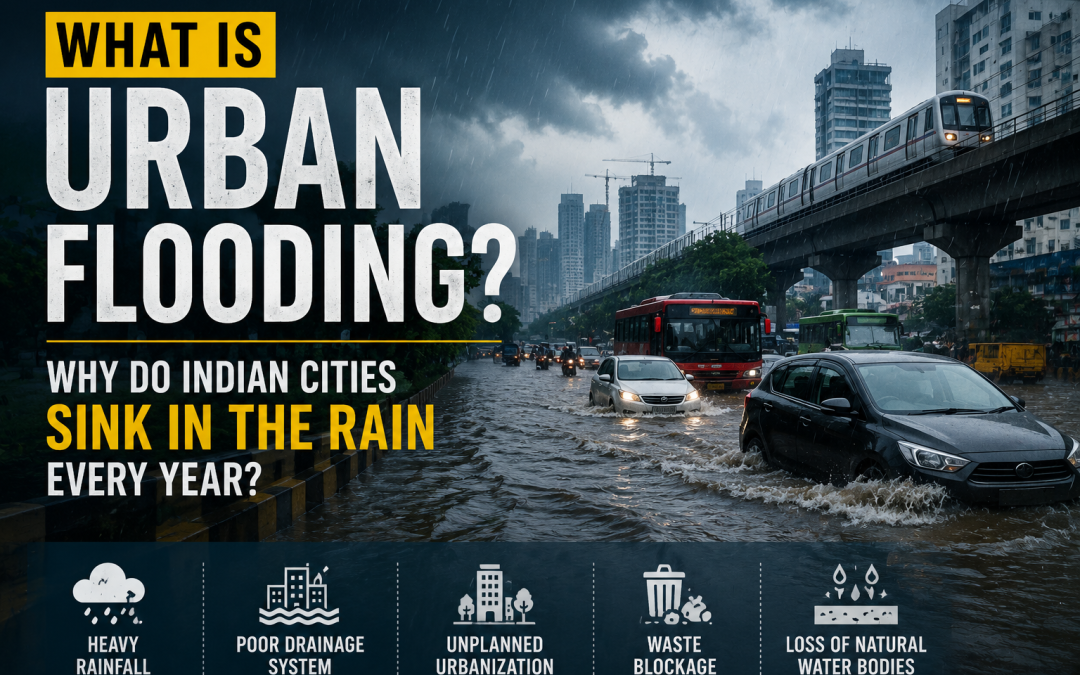
Urban flooding means when a city gets filled with water due to heavy rain and the water has nowhere to go. Roads, homes, and offices go underwater – sometimes within just a few hours of rain.
This is different from river flooding. In river flooding, a river overflows and enters nearby areas. In urban flooding, the city itself cannot drain the rainwater fast enough – and everything gets submerged.
🏙️ Which Indian Cities Face This Every Year?
This is not just a Mumbai problem. Almost every big city in India faces urban flooding during monsoon. Here is a quick look at recent major events:
- 🔴 Mumbai 2026 – Heavy monsoon rains flooded Saki Naka, Andheri, King Circle, and Everard Nagar just this week on July 3, 2026. The Mumbai-Pune highway was shut due to landslides.
- 🔴 Delhi 2023 – Recorded 228.1 mm of rain in just 24 hours – more than the entire average June rainfall. Yamuna River overflowed into the city.
- 🔴 Bengaluru 2022 – IT companies like Wipro and Infosys suffered losses of over Rs 1,800 crore. Lakes overflowed into residential areas and tech parks.
- 🔴 Chennai 2015 – One of India’s worst urban floods ever. Damages crossed Rs 15,000 crore. Entire neighbourhoods were submerged for days.
- 🔴 Hyderabad 2020 – Over 70 people died. Cars were swept away in floodwater in the middle of the city.
🔍 Why Does Urban Flooding Happen? 5 Main Reasons
🏗️ 1. Old and Outdated Drains
Mumbai’s drainage system was built by the British in the 1860s. It was designed to handle 25 mm of rain per hour. But today Mumbai gets more than 100 mm of rain per hour during heavy spells. The drains simply cannot handle this much water.
🧱 2. Too Much Concrete, No Open Land
When it rains in a forest or a field, the soil absorbs the water naturally. But in cities, everything is covered with concrete – roads, footpaths, parking lots, and buildings. Water cannot sink into the ground. It just runs on top and floods the streets.
🏞️ 3. Lakes and Wetlands Have Been Destroyed
Bengaluru once had over 1,000 lakes. Today fewer than 80 of them are still working properly. The rest have been filled up and built over. These lakes used to absorb rainwater and store it. Now that they are gone, the water has nowhere to go.
🗑️ 4. Drains Are Blocked by Garbage
Plastic bags, food wrappers, and other garbage thrown on streets eventually end up blocking drains. When rain comes, water cannot pass through blocked drains and it overflows onto roads and into homes.
🌡️ 5. Climate Change is Making Rain More Extreme
Due to climate change, the same amount of rain that used to fall over a whole month is now falling in just a few hours. These short but extremely heavy rain bursts are called cloud bursts. Our cities were never designed to handle such intense rainfall in such short time.
😟 What Damage Does Urban Flooding Cause?
❌ Loss of Lives
Around 500 people die in urban floods every year in India according to NDMA estimates. People drown, get electrocuted by fallen wires, or are swept away in fast-moving floodwater.
❌ Economic Losses
Mumbai’s flooding in 2005 caused commercial losses of over Rs 700 crore in a single day. Bengaluru’s 2022 floods cost the IT industry over USD 220 million. Every flood means lost business, damaged goods, and costly repairs.
❌ Health Crisis
Stagnant floodwater becomes a breeding ground for mosquitoes. After every flood, cities see a sharp rise in diseases like dengue, malaria, cholera, typhoid, and leptospirosis.
❌ Poor People Suffer the Most
People living in slums and low-lying areas are always the worst hit. They lose their homes, belongings, and livelihoods. Richer areas recover faster. Poorer areas stay flooded longer.
🏛️ What is the Government Doing?
AMRUT 2.0 Mission
The Atal Mission for Rejuvenation and Urban Transformation (AMRUT) 2.0 includes improving stormwater drainage systems in cities across India. It focuses on making cities more water-resilient.
Smart Cities Mission
Under this mission, cities like Mumbai have set up ICT-enabled flood monitoring systems. Mumbai’s IFLOWS system gives real-time flood warnings to help people prepare before flooding happens.
Urban Disaster Management Authority (UDMA)
The Disaster Management Amendment Bill 2024 proposes setting up a dedicated Urban Disaster Management Authority for big cities. This body will specifically handle urban flood preparedness and response.
Brimstowad Project in Mumbai
This project was started in 2007 to upgrade Mumbai’s drainage from handling 25 mm of rain per hour to 50 mm per hour. Unfortunately, progress has been very slow even after almost 20 years.
💡 What Should Actually Be Done? Solutions
- Restore and protect lakes, wetlands, and natural water bodies in and around cities
- Build porous roads and pavements that allow rainwater to soak into the ground
- Upgrade drainage systems to handle modern rainfall levels – not 1860s British designs
- Stop all construction on floodplains and low-lying areas near water bodies
- Strictly penalize garbage dumping in drains and water bodies
- Set up real-time flood warning systems in every major city
- Plant more trees and create green spaces to absorb rainwater naturally
Over 70% of Indian urban areas lack scientifically designed stormwater drains. Most city drainage systems were built for rainfall of 12 to 20 mm per hour – but today cities regularly receive 50 to 100 mm per hour during cloud bursts.
📝 Quick Recap – Remember for UPSC!
- Urban Flooding = When a city cannot drain rainwater fast enough and roads and homes get submerged.
- Worst affected cities – Mumbai, Delhi, Bengaluru, Chennai, Hyderabad, Kolkata every monsoon season.
- 5 main reasons – Old drains, too much concrete, destroyed lakes, blocked garbage, and extreme rainfall due to climate change.
- Effects – loss of lives, economic damage, diseases like dengue and cholera, and poor communities suffer the most.
- Government steps – AMRUT 2.0, Smart Cities Mission, IFLOWS in Mumbai, and proposed Urban Disaster Management Authority (UDMA).
- UPSC has asked questions on urban flooding in 2016 and 2020 – it is a high-priority exam topic.